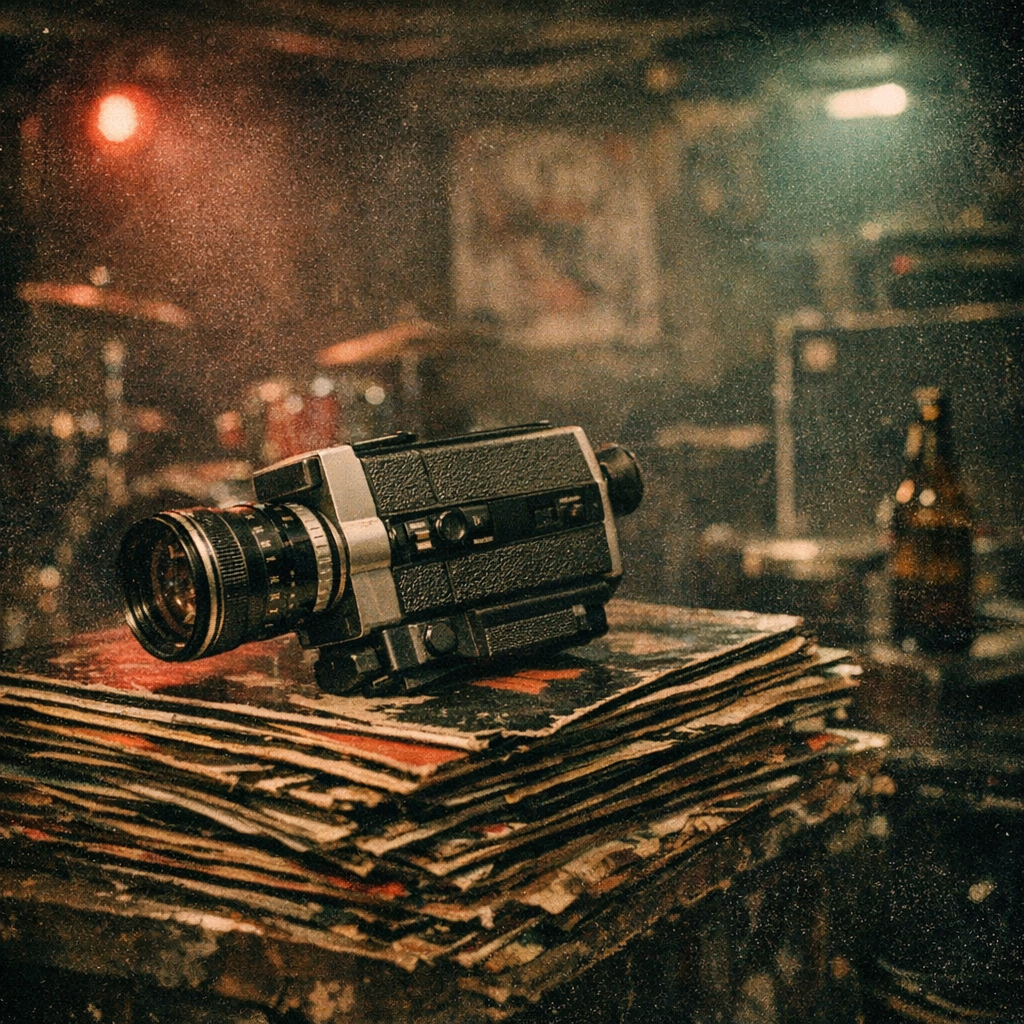
The camera was a gift. Around the time the Roxy opened, the fashion editor Caroline Baker handed a Super 8 camera to Don Letts, the young DJ who was playing reggae between the bands at a new club in Covent Garden. Letts had never made a film. He pointed the camera at the stage, the toilets, the dressing rooms and the crowd, kept buying cartridges with whatever money he could raise, and ended up with the rawest document of London punk’s first months. Released in 1978 under the plain title The Punk Rock Movie, it is still the film people mean when they talk about seeing what the Roxy was actually like. This guide covers the punk rock movie 1978 release in full: how it was made, who is in it, how it reached audiences and why it matters.
The Punk Rock Movie (1978) at a glance
| Detail | What is documented |
|---|---|
| Title | The Punk Rock Movie (also circulated as The Punk Rock Movie from England) |
| Director and camera | Don Letts |
| Format | Super 8, shot handheld |
| Main location | The Roxy, 41–43 Neal Street, Covent Garden, London |
| Shot | Mainly the first months of 1977 |
| First public showing | A preliminary cut of about an hour at the Institute of Contemporary Arts, London, in autumn 1977 |
| Release | Limited theatrical release in the UK in 1978 |
| Country / language | United Kingdom / English |
Running times quoted for the finished film vary between home-video editions, so I have left a single figure out rather than guess.
The Roxy and the man behind the decks
Before the Roxy, Letts managed Acme Attractions, a clothing shop on the King’s Road where he played dub and reggae for the customers. The crowd that hung around the shop overlapped heavily with the people who would form and follow the first punk bands. When Andrew Czezowski, together with Susan Carrington and Barry Jones, turned the premises at 41–43 Neal Street into a dedicated punk venue, Letts became its resident DJ.
The Roxy’s first gig, featuring Generation X, took place on 14 December 1976, and the official opening night on 1 January 1977 was headlined by the Clash with Johnny Thunders and the Heartbreakers. The club’s punk heyday was short, roughly the first hundred days of 1977, before its original management left and the place changed hands. A plaque on the building now marks it as a legendary punk club of 1976 to 1978.
Letts’s own contribution to the music is part of the legend. Because there were very few punk records to play in those first weeks, he filled the gaps between bands with reggae, and the punk audience took to it. That crossover between punk and Jamaican music ran through the late-1970s London scene and through Letts’s whole career.
How the film was made
Letts has described the project as a decision to film continuously for about three months. He financed it from his DJ fees and shop income, selling possessions to keep buying film. Super 8 cartridges were short, so the footage arrives in bursts: a song or two from a band, then a cut to the crowd, a band backstage, a fight over a microphone, someone being sick. There is no narration, no interviews in the conventional documentary sense and no attempt to explain punk to outsiders.
Most of the live footage comes from the Roxy itself. The notable exception is the Sex Pistols, who were filmed at the Screen on the Green cinema in Islington on 3 April 1977, one of Sid Vicious’s earliest appearances with the band. Letts also filmed on tour buses and in other London locations, and the film closes with footage shot in Jamaica.
When an early version of roughly an hour played at the Institute of Contemporary Arts in the autumn of 1977, it attracted enough attention that Time Out ran a cover story on punk home movies. That reaction helped push the project toward a proper release the following year.
Who appears in The Punk Rock Movie
The film is a roll call of the bands that passed through the Roxy and the wider London scene in early 1977:
- The Clash
- Sex Pistols
- Siouxsie and the Banshees
- The Slits
- Generation X
- Wayne County & the Electric Chairs
- Slaughter and the Dogs
- Eater
- Subway Sect
- X-Ray Spex
- Alternative TV
- Johnny Thunders and the Heartbreakers
John Lydon, Sid Vicious and the scene figure Soo Catwoman are usually listed as its featured faces. Some of the most valuable footage is backstage: Generation X, the Slits and Siouxsie and the Banshees are all caught off stage as well as on. Sharp-eyed viewers also point out a teenage Shane MacGowan in the audience, pogoing in a Union Jack jacket.
Among the performances listed on the 1987 VHS edition are the Sex Pistols’ “God Save the Queen,” the Clash’s “White Riot,” Siouxsie and the Banshees’ “Carcass,” Johnny Thunders and the Heartbreakers’ “Chinese Rocks” and X-Ray Spex’s “Oh Bondage! Up Yours!”
What the film is like to watch
The first thing that strikes you is how small everything looks. The Roxy was a cramped basement, and Letts was standing in the middle of it rather than filming from a respectful distance. The picture is grainy, the color shifts, and the camera moves with the crowd. It is not a concert film in the polished sense; it is closer to a home movie made by someone who happened to be at the center of a cultural moment.
That is also why it has lasted. Later punk documentaries rely on interviews and hindsight. The Punk Rock Movie has none; nobody yet knew which bands would matter. Several of the groups in it would split within a few years. The movie records them before the history was written.
Release history and the soundtrack question
The film received a limited cinema release in 1978 and then moved through a series of small video labels. Documented editions include:
| Year | Edition |
|---|---|
| 1978 | Limited theatrical release; early video edition from Sun Video |
| 1980 | Video release from Danton Video |
| 1987 | VHS edition with a published segment listing |
| 1992 | Video release from Studio K7 |
| 2006–2008 | DVD editions, including a 2006 North American release through Capitol/EMI |
The DVD versions were not universally welcomed. Reviewers and fans complained about the digital transfers and the sound, and in particular noted that parts of the soundtrack used overdubbed or substituted recordings rather than the original live audio captured in the club. Anyone comparing editions should know that the audio can differ from one release to the next.
As for preservation, there is no widely published account of where the original Super 8 elements are held or of a modern archival restoration. That is a gap worth stating plainly: the film survives in circulation through its video and DVD releases, but its long-term archival status is not documented in the sources I could check.
What Don Letts did next
The Punk Rock Movie launched a long career behind the camera. Letts became the Clash’s regular music-video director and also made videos for artists including the Pretenders, the Psychedelic Furs, Elvis Costello and Musical Youth. From the mid-1980s he was a member of Big Audio Dynamite with former Clash guitarist Mick Jones, handling samples and visuals.
He directed the Jamaican feature Dancehall Queen (1997), and his documentary The Clash: Westway to the World (2000) won a Grammy Award. Later documentaries include Punk: Attitude (2005) and The Story of Skinhead (2016), and Rebel Dread (2022) is a film about his own story. The first film remains the one that made his name, and it is often cited alongside other low-budget, outsider films that built audiences outside the mainstream, the same path traced by the best cult movies of the period.
Why it still matters
Punk’s legend has been retold so many times that it can feel like a set of poses. The Punk Rock Movie is an antidote: messy, partial and unedited by hindsight. It shows a scene that was smaller, younger and more improvised than the myths suggest. For anyone interested in how music films, home movies and the late-show circuit fed one another in the 1970s, it belongs next to the films that played the midnight movie screens of the same decade. Where it can be seen today, it is through licensed services or physical media releases.
Where to go next
For more films that found their audience the hard way, read about Jodorowsky’s unmade King Shot, or browse the Cult Movies section.