Nobody in Casablanca ever says “Play it again, Sam.” Ilsa asks Sam to play it once, “for old times’ sake,” then simply says “Play it, Sam.” Later Rick, drunk and bitter, demands the same song. The misquote has outlived generations of viewers, which tells you something about Casablanca 1942: it is a film so thoroughly absorbed into popular memory that people remember lines it never contained. It was not made as a monument. It was a busy studio’s next picture, shot over one summer, and it became the best-loved film Hollywood produced in those years.
Casablanca 1942: credits at a glance
| Credit | Details |
|---|---|
| Studio | Warner Bros. |
| Director | Michael Curtiz |
| Producer | Hal B. Wallis |
| Screenplay | Julius J. Epstein, Philip G. Epstein, Howard Koch (Casey Robinson contributed uncredited work) |
| Source | The unproduced play Everybody Comes to Rick’s by Murray Burnett and Joan Alison |
| Cinematography | Arthur Edeson |
| Editing | Owen Marks |
| Music | Max Steiner; “As Time Goes By” by Herman Hupfeld |
| Filming | May 25 to August 3, 1942, mostly at the Warner lot in Burbank |
| Premiere | November 26, 1942, New York City; general US release January 23, 1943 |
| Running time | 102 minutes |
| Main cast | Humphrey Bogart (Rick Blaine), Ingrid Bergman (Ilsa Lund), Paul Henreid (Victor Laszlo), Claude Rains (Captain Louis Renault), Conrad Veidt (Major Strasser), Sydney Greenstreet (Signor Ferrari), Peter Lorre (Ugarte), Dooley Wilson (Sam) |
From an unproduced play to a studio picture
The source was a play by Murray Burnett and Joan Alison, Everybody Comes to Rick’s, which had not been staged when Warner Bros. bought it in the weeks after Pearl Harbor. Hal B. Wallis, then the studio’s head of production, assigned it as one of the many features Warner turned out each year. The title was reportedly chosen to echo the exotic appeal of Algiers, a 1938 hit set in North Africa.
The writing went through several hands. Twin brothers Julius and Philip Epstein, known for their quick, witty dialogue, shaped much of the humor and Renault’s cynicism. Howard Koch added political weight and worked on Rick’s backstory. Casey Robinson, uncredited, worked on the romance. The script was still being revised while the cameras rolled, which led to the persistent story that nobody on set knew how the film would end.
That story is partly true. Koch later recalled the production not having an ending in the early weeks, and different possibilities were discussed, including one in which Laszlo is killed. But film historian Aljean Harmetz, examining the surviving scripts, found that many of the key scenes were shot after the ending had been settled. Roger Ebert’s description is a good one: the confusion on the set was emotional rather than factual. Whatever the actors knew, the film ended with the uncertainty intact on Bergman’s face, and that is what audiences see.
The casting myths
Two persistent stories deserve correction. An early studio press item mentioned Ronald Reagan, which gave rise to the claim that he was the first choice for Rick. The studio knew Reagan was about to go into military service, and he was never seriously considered. George Raft later claimed he had turned the role down, but studio records indicate that Wallis wanted Bogart from the beginning.
Timing and the world outside the studio
The film is set in December 1941, in a French Moroccan city under the authority of Vichy France, where refugees wait for exit visas to Lisbon and from there to America. Then history caught up with it. On November 8, 1942, Allied forces landed in North Africa, including at Casablanca, and Warner moved quickly to put the film in front of an audience. It premiered in New York later that month. The general release followed on January 23, 1943, in the same month that Roosevelt and Churchill met at the Casablanca Conference. No marketing department could have planned that kind of publicity.
The film’s sense of displacement was not just an invention. Many of the actors were themselves European exiles who had fled the Nazis. Conrad Veidt, who played the German Major Strasser, had left Germany in the 1930s. Peter Lorre and Paul Henreid had also left Europe. Their presence gives the background scenes in Rick’s café a weight that more ordinary studio extras could not have.
The scenes everyone remembers
“La Marseillaise”
German officers in Rick’s café gather around the piano to sing “Die Wacht am Rhein.” Laszlo goes to the band and tells them to play “La Marseillaise.” Rick nods his permission. The French anthem rises, the whole room joins in, and the Germans are drowned out. Watch the faces of the extras, many of them refugees. The emotion is unforced. For many viewers, this is the scene that makes the film more than a romance.
The flashback to Paris
The Paris flashback, with Rick and Ilsa in brief happiness before the German army arrives, explains the bitterness Rick has carried to Morocco. It is short and lightly done, and it gives meaning to a line that comes much later: “We’ll always have Paris.”
The airport
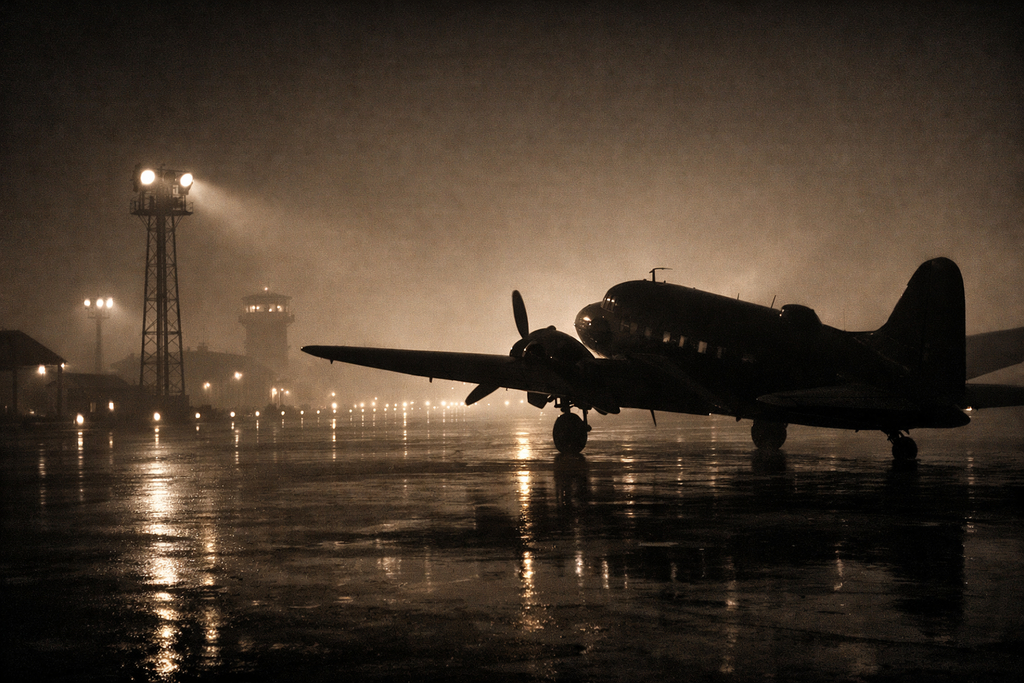
The final sequence, shot on a soundstage with fog and a model plane, is one of the most studied endings in American film. Without giving away the details, it turns on a choice about duty and love, and on Rick’s decision about who he wants to be. Claude Rains gets the last great laugh in the film, and the closing line, “Louis, I think this is the beginning of a beautiful friendship,” was settled only after Wallis weighed alternatives.
The dialogue
The American Film Institute’s 2005 list of the hundred greatest movie quotes included six lines from Casablanca, more than from any other film, with “Here’s looking at you, kid” placed highest. Bogart is reported to have used that phrase off camera with Bergman before it went into the film; accounts of its origin vary, so I treat that one as a good story rather than a fact.
Other lines are in the vocabulary of people who have never seen the film:
- “Of all the gin joints in all the towns in all the world, she walks into mine.”
- “Round up the usual suspects.”
- “I’m shocked, shocked to find that gambling is going on in here!”
- “We’ll always have Paris.”
The secret is economy. The Epsteins’ jokes are cynical but never cruel, and Koch’s more serious material is short enough not to slow the story. Claude Rains, who gets several of the best lines as the corrupt, likable Renault, plays them so lightly that you hardly notice the craft. If you enjoy the quote side of classic film, our movie quote trivia page has more.
Awards and reputation
Casablanca received eight Academy Award nominations and won three: Best Picture, Best Director for Michael Curtiz and Best Screenplay. The Best Picture win at the ceremony in March 1944 came with a famous moment of studio politics: when the award was announced, Jack Warner hurried to the stage to accept it before Wallis, the film’s actual producer, could. Wallis described it as humiliating, and he left Warner Bros. soon afterward.
In 1989 the film was among the first twenty-five titles selected for the National Film Registry by the Library of Congress. The American Film Institute ranked it second on its 1998 list of the greatest American films and third on the 2007 update.
Why it still works
Casablanca is often held up as proof that the old studio system, at its best, could produce art almost by accident: a film assembled by contract players, contract writers and a contract director, on a schedule, that somehow holds together perfectly. That is part of the truth. The other part is that every element is pulling in the same direction. Max Steiner’s score keeps returning to “As Time Goes By.” Arthur Edeson’s lighting turns Rick’s café into a place of shadows and escape routes. Curtiz keeps the pace brisk enough that the melodrama never sags.
And under the romance sits a real question about what private feelings are worth in a world at war. In 1942 that question was not abstract. It still lands.
The film has been restored and reissued many times and may be found through licensed services. For other films from the same period, our Golden Age Hollywood section is a good place to browse.
Where to go next
Casablanca is one of our 40 classic movies to watch. For a much darker look at Hollywood from the inside, read our piece on Sunset Boulevard (1950).