At seven in the morning on June 12, 1962, a guard on Alcatraz tried to wake a prisoner who would not stir. The head on the pillow turned out to be made of soap, toilet paper and concrete dust, painted and topped with real hair swept from the prison barbershop floor. Frank Morris and the brothers John and Clarence Anglin had been gone for roughly nine hours. Seventeen years later Don Siegel turned that night into Escape from Alcatraz, and the 1979 film remains the version of the story most people carry in their heads. This is a look at both: the escape from Alcatraz 1979 audiences saw, and the one that actually happened.
Escape from Alcatraz 1979: credits at a glance
| Credit | Details |
|---|---|
| Director and producer | Don Siegel |
| Screenplay | Richard Tuggle |
| Source | Escape from Alcatraz (1963), nonfiction book by J. Campbell Bruce |
| Production / distribution | The Malpaso Company / Paramount Pictures |
| US release | June 22, 1979 |
| Running time | 112 minutes |
| Cinematography | Bruce Surtees |
| Editing | Ferris Webster |
| Music | Jerry Fielding |
| Main cast | Clint Eastwood (Frank Morris), Patrick McGoohan (the Warden), Fred Ward (John Anglin), Jack Thibeau (Clarence Anglin), Larry Hankin (Charley Butts), Roberts Blossom (Chester “Doc” Dalton), Paul Benjamin (English), Bruce M. Fischer (Wolf), Frank Ronzio (Litmus) |
The film is also remembered as the first screen appearance of Danny Glover, who has a brief part as an inmate, and as the fifth and last film Siegel and Eastwood made together, after Coogan’s Bluff, Two Mules for Sister Sara, The Beguiled and Dirty Harry.
What really happened in June 1962
Alcatraz Federal Penitentiary was built to hold men who had caused trouble elsewhere, and it had a reputation as the prison nobody left. Frank Morris, born in 1926, had a record of escapes behind him. John and Clarence Anglin, born in 1930 and 1931, were bank robbers from a Florida farming family. A fourth man, Allen West, was part of the plan from the start and later claimed it had been his idea.
Over months, the men widened the ventilation openings beneath the sinks in their cells. Accounts of the escape list saw blades, metal spoons from the mess hall and an improvised electric drill built around a vacuum cleaner motor. Morris played an accordion during the evening music hour, which helped cover the noise. Behind the cells ran an unguarded utility corridor, and from there the men climbed to the unused top level of the cellblock, which they turned into a hidden workshop.
That is where they built the raft: more than fifty prison raincoats, glued and stitched into a craft of roughly six by fourteen feet, reportedly following a design they had seen in a 1962 issue of Popular Mechanics. They also made life vests and plywood paddles. The dummy heads went into the beds so that the night counts would pass.
On the night of June 11, Morris and the Anglins slipped out through their vents. West could not get out in time; cement he had used to hold his own grille in place had hardened and narrowed the opening. The other three climbed a ventilation shaft to the roof, slid down a kitchen vent pipe of about fifty feet, crossed two fences and launched from the northeast shore near the power plant at around ten o’clock.
What was found afterward
The escape was not discovered until morning. In the following days searchers recovered a paddle near Angel Island, a plastic-wrapped packet of personal photographs and contact details linked to the Anglins, and pieces of life vests that washed up on both sides of the bay. No bodies were ever identified. The FBI closed its file on December 31, 1979, concluding that the men most likely drowned in the cold, fast water. The U.S. Marshals Service, which handles federal fugitives, kept its own case open for decades afterward.
Alcatraz itself did not last long. Attorney General Robert F. Kennedy ordered it closed, and the last prisoners left on March 21, 1963, for reasons that had more to do with cost and the crumbling buildings than with this one escape.
Later claims have kept the story alive: a 2015 television documentary presented photographs said to show the Anglin brothers in Brazil in the 1970s, and in 2018 a letter received years earlier by San Francisco police, signed as John Anglin, was made public. Investigators described the letter’s authenticity as inconclusive, and the photographs were disputed. None of it has settled what happened to the three men, and I would treat any confident answer with suspicion.
From book to screen
J. Campbell Bruce’s book, published in 1963, covered the history of escape attempts from the island, with the Morris-Anglin breakout as its centerpiece. Richard Tuggle, then a newcomer, adapted it into a script that strips the story to its working parts: a man arrives, studies the place, finds his tools and his partners, and goes. Siegel produced and directed, and Eastwood’s own company, Malpaso, was involved in the production.
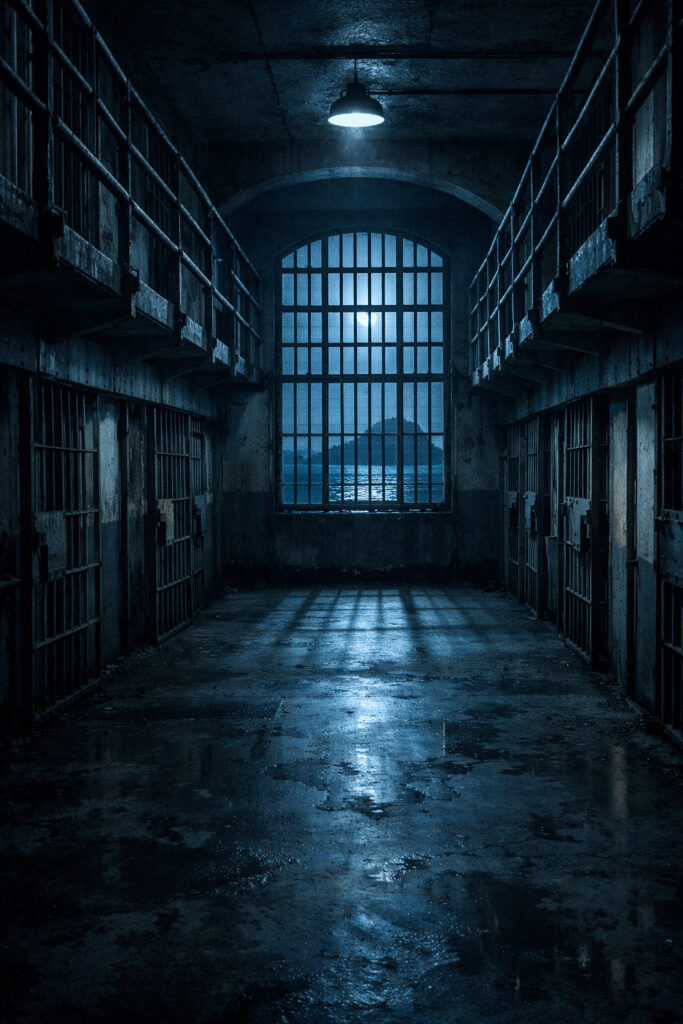
The production shot on Alcatraz itself, by then a national park site, working largely at night to stay clear of tourist groups. The decaying cellblock needed substantial restoration before it could be filmed, and some interiors were recreated elsewhere for practical reasons. Bruce Surtees, who shot several Eastwood pictures of the period, lit the cells in hard, cold contrasts, and the result looks less like a set than a place where the paint is genuinely peeling.
The film itself (spoiler-light)
The opening is close to wordless. Morris arrives by boat in a rainstorm, is processed, stripped and walked naked to his cell, and the door slams. Siegel lets several minutes pass before anything resembling conventional dialogue starts, and that patience sets the rhythm for everything that follows.
Inside, Morris meets a small society: English, who runs the library cart and sizes him up warily; Litmus, an older inmate with a pet mouse; Doc, a painter whose canvases are his only privilege; the bully Wolf; and Charley Butts, the nervous neighbor who stands in for the real Allen West. Patrick McGoohan’s warden is the film’s invention, a cold, precise bureaucrat who treats small cruelties as policy. The real warden at the time, Olin Blackwell, was reportedly away on vacation the night of the escape.
The middle stretch is a procedural, and a very satisfying one. We watch Morris notice the rotten concrete around the vent grille, pocket a nail clipper, test glue, shape the papier-mâché head and pace out the timing of the guards’ counts. Siegel shoots the work in close detail without hurrying it. When the night comes, the tension comes from things we have already been taught to watch for: the counts, the noises, the grille that will not move.
What the film changed
- The Warden is fictional, as is his personal feud with Morris.
- Charley Butts is based on Allen West but written as more timid than West appears to have been.
- Doc’s story, including his shocking act of protest, draws on an earlier and unrelated Alcatraz incident from the 1930s.
- The chrysanthemum that recurs through the film, and its use in the final scene, are dramatic inventions.
- The timeline is compressed, and the film’s version of who did which work is simplified.
None of this undercuts the core of the film, which follows the documented method of the escape closely enough that the real tools and route are recognizable on screen.
Reception and why it holds up
The film opened in June 1979 to largely positive reviews and was a solid commercial success for Paramount, among the higher-grossing releases of that year. Roger Ebert gave it three and a half stars out of four. It has aged better than many prison pictures of its decade because it refuses to explain itself. There are no flashbacks to Morris’s crimes, no speeches about freedom and very little backstory for anyone.
That restraint is Siegel’s signature. He had made Riot in Cell Block 11 back in 1954 and knew how to make institutional routine feel threatening. Eastwood, for his part, plays Morris as a man who listens more than he talks, which suits a role built almost entirely out of watching. McGoohan gives the warden a clipped stillness that is more unnerving than shouting would be. If you like the stripped-down crime films covered in our guide to neo-noir, this one sits comfortably beside them.
The ending, deliberately open, mirrors the historical record. The film does not tell you whether the men reached shore, because nobody knows. In 1979 that was a bold choice for a mainstream star vehicle; today it simply reads as honest.
Seeing it today
The film has been released on home video many times and may be found through licensed services. Alcatraz Island is now part of the Golden Gate National Recreation Area, and visitors to the cellhouse can see the cells associated with the escape, which gives the film a strange second life: the set is still standing, and still cold.
For other films that reward the same kind of patience, our classic film reviews section collects more long looks at single titles.
Where to go next
If the tight, unshowy craft of this film appeals to you, read our list of the best old movies that still feel modern, or step further back to the best film noir movies that shaped crime cinema.