Bela Lugosi died in August 1956, a few months before Edward D. Wood Jr. began shooting his next picture. Wood had a few minutes of silent footage of the old Dracula star filmed for another project, so he built the new film around it, and when he needed more Lugosi he used a stand-in, Tom Mason, who held a cape over the lower half of his face. The result, Plan 9 from Outer Space, would one day be named the worst film ever made. It is also one of the most watched and most loved films of its kind. That contradiction is the heart of so bad it’s good movies: the films that fail so sincerely, and so specifically, that watching them becomes a pleasure of its own.
What makes so bad it’s good movies work?
Plenty of films are bad without being fun. The ones that become cult favorites usually share a few qualities:
- Sincerity. The filmmakers clearly believed in what they were doing. Cynical, lazy films are boring; earnest, ambitious failures are fascinating.
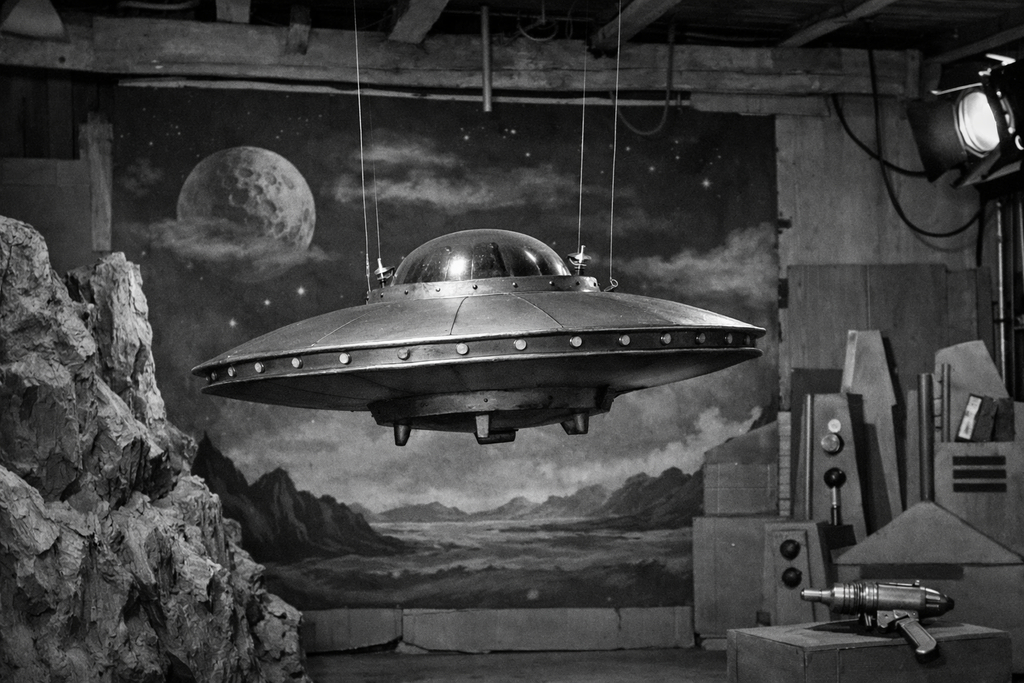
- Ambition beyond the means. Flying saucers, alien invasions and monster attacks made with almost no money produce the visible strings and cardboard sets that audiences treasure.
- Strange decisions. Dialogue nobody would say, scenes that go nowhere, edits that skip logic: the more specific the oddity, the more quotable the film.
- A crowd. These films are best watched with other people. The laughter, heckling and repeated lines are the real event.
That last point links the genre to the late-show tradition. The revival of the 1936 scare film Reefer Madness as a camp attraction in the early 1970s helped establish the habit of watching an earnest old film for its unintended comedy, and later “bad movie” screenings grew out of the same circuit described in the history of midnight movies.
The classics of glorious failure
| Film | Year | Director | Why fans love it |
|---|---|---|---|
| Robot Monster | 1953 | Phil Tucker | An alien invader played by a man in a gorilla suit wearing a diving helmet |
| Plan 9 from Outer Space | 1957 | Edward D. Wood Jr. | Graverobbing aliens, posthumous Lugosi footage and fearless continuity errors |
| Santa Claus Conquers the Martians | 1964 | Nicholas Webster | Martians kidnap Santa so their children can have Christmas |
| Manos: The Hands of Fate | 1966 | Harold P. Warren | A regional horror film rescued from obscurity by television mockery |
| Troll 2 | 1990 | Claudio Fragasso | A sequel in name only, with goblins rather than trolls and unforgettable line readings |
| The Room | 2003 | Tommy Wiseau | A melodrama that became the most famous participation film since Rocky Horror |
Robot Monster (1953)
Made quickly and cheaply in the brief 1950s boom for 3-D, Robot Monster imagines an alien called Ro-Man who has wiped out nearly all of humanity. The creature is a performer in a gorilla suit topped with a diving helmet and antennae, and much of the action takes place in the rocky hills outside Los Angeles. Its makers clearly had grand ideas and almost no means, which is exactly the formula. It also has a score by a young Elmer Bernstein, later the composer of The Magnificent Seven, which makes the whole thing stranger still.
Plan 9 from Outer Space (1957)
Wood shot his film in November 1956 under the title Grave Robbers from Outer Space, a phrase that survives in the opening narration by the television psychic Criswell. Turner Classic Movies has described how a Baptist organization helped finance the production. The cast includes the wrestler Tor Johnson and Maila Nurmi, television’s Vampira, alongside the Lugosi footage. It premiered in Los Angeles in 1957 and reached wider distribution later in the decade before settling into a long life on television.
Its reputation was sealed in 1980, when Michael and Harry Medved’s book The Golden Turkey Awards named it the worst film ever made and gave Wood a posthumous award as worst director. Rather than burying the film, the title made people seek it out. Tim Burton’s Ed Wood (1994), with Johnny Depp as Wood and Martin Landau in an Oscar-winning performance as Lugosi, turned the story of its making into an affectionate tribute.
Manos: The Hands of Fate (1966)
Manos was made in and around El Paso, Texas, by Harold P. Warren, a local fertilizer salesman who wanted to prove that a horror film could be made cheaply outside Hollywood. A family on a road trip ends up at a lodge run by a cult and its strange caretaker, Torgo. The film disappeared almost at once. Its second life came decades later, when it was featured on Mystery Science Theater 3000 in the early 1990s, and it has since been restored by fans and screened at revival events. It is a reminder that “worst ever” lists often depend on which bad films happen to be rediscovered.
Troll 2 (1990)
An Italian director and crew made Troll 2 in Utah with a largely inexperienced American cast, and its link to the earlier film Troll is in name only; the creatures are goblins, and there are no trolls at all. For years it was simply a cheap horror picture on the video shelf. Then audiences began throwing screenings for it, and the documentary Best Worst Movie (2009), directed by Michael Stephenson, who had played the film’s young lead, followed the cast as they discovered they had become cult figures. Part of the appeal, as many fans point out, is the director’s evident sincerity.
The Room (2003)
Tommy Wiseau wrote, directed, produced and starred in The Room, a melodrama about a love triangle in San Francisco. It played briefly in Los Angeles in 2003, backed by a billboard that stayed up for years, and was soon picked up as a monthly midnight show. Audiences developed rituals of call-outs and thrown plastic spoons, and the screenings spread internationally. Greg Sestero, one of its actors, co-wrote with Tom Bissell a book about the production, The Disaster Artist (2013), which James Franco adapted as a film in 2017.
How television made bad movies a hobby
Two forces turned “bad movie” viewing from a private joke into a shared culture. The first was late-night television, which filled hours of airtime with cheap genre pictures and introduced generations of insomniacs to Ed Wood and his peers. The second was Mystery Science Theater 3000, created by Joel Hodgson, which began in 1988 on a Minneapolis station. Its format, silhouetted figures making jokes at the screen, formalized what audiences were already doing in theaters and living rooms. It made Manos famous, and its influence lives on in live riffing shows and screening events.
The Medveds’ books played a part as well. Harry Medved had already co-written The Fifty Worst Films of All Time (1978) with Randy Dreyfuss before the brothers produced The Golden Turkey Awards. By ranking the worst films, these books created a canon, and a canon is something people want to complete. Fans began hunting down the titles on late-night broadcasts and, later, on video, turning a list meant as a joke into a viewing checklist.
Is it cruel to laugh?
It is a fair question. Most of these films were made by people who were trying hard, often with their own money. The best bad-movie culture, though, tends to be affectionate rather than mocking. Ed Wood celebrated its subject’s optimism; Best Worst Movie showed former cast members enjoying their unexpected fame; and the audiences who return to these films again and again plainly love them. A movie that brings strangers together for a night of shared delight has succeeded at something, even if it was not what its makers intended.
There is also something instructive here. Watching a film fall apart shows how much invisible skill goes into one that holds together: continuity, pacing, performance, editing. Many film lovers credit bad movies with teaching them how movies work.
How to host a bad-movie night
- Pick the right film. Sincere, ambitious, short. A long, dull failure will empty the room.
- Invite a crowd. Three or more people is the minimum for proper heckling.
- Add context. A few words about how the film was made, like the Lugosi footage in Plan 9, sharpen the fun.
- Stay legal. Many older titles are available through licensed services or physical media, and some have fallen into public-domain archives.
These films sit at the far end of the spectrum covered by the best cult movies, and they prove that a film’s audience can rewrite its fate.
Where to go next
For more low-budget spaceships and strange futures, read about cult sci-fi movies, or test yourself with some movie trivia.