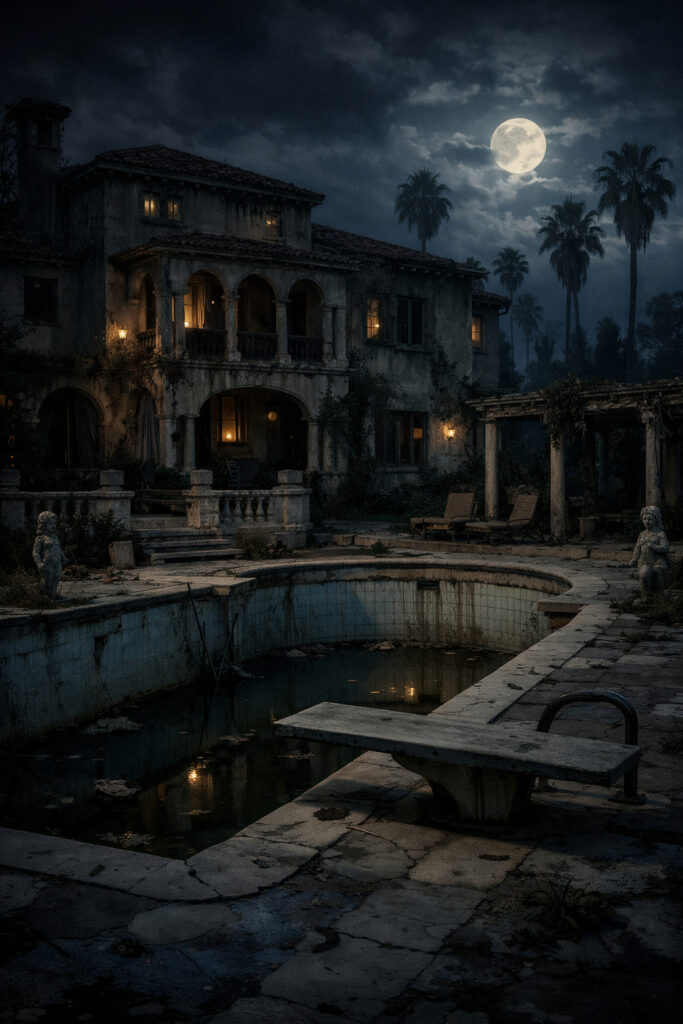
A body floats face down in a Hollywood swimming pool, photographed from below as police flashbulbs pop overhead. Then the dead man starts talking. That is how Sunset Boulevard 1950 opens, and it tells you at once that Billy Wilder is not going to make a polite film about the movie business. Seventy-plus years later, it remains the sharpest picture Hollywood has made about itself: a noir, a dark comedy and a ghost story, starring an actual silent-era legend as a forgotten one.
Sunset Boulevard 1950: credits at a glance
| Credit | Details |
|---|---|
| Studio | Paramount Pictures |
| Director | Billy Wilder |
| Producer | Charles Brackett |
| Screenplay | Charles Brackett, Billy Wilder, D. M. Marshman Jr. |
| Cinematography | John F. Seitz |
| Music | Franz Waxman |
| Editing | Arthur P. Schmidt, Doane Harrison |
| Art direction | Hans Dreier, John Meehan |
| Costumes | Edith Head |
| Premiere | August 10, 1950, Radio City Music Hall, New York |
| Running time | 110 minutes |
| Main cast | William Holden (Joe Gillis), Gloria Swanson (Norma Desmond), Erich von Stroheim (Max von Mayerling), Nancy Olson (Betty Schaefer) |
| Appearing as themselves | Cecil B. DeMille, Hedda Hopper, Buster Keaton, Anna Q. Nilsson, H. B. Warner |
The story, without spoilers past the first reel
Joe Gillis is a screenwriter with no money, no assignments and two men from a finance company trying to repossess his car. Fleeing them, he swerves into the driveway of a crumbling mansion on Sunset Boulevard. Inside lives Norma Desmond, once one of the great stars of silent film, now living with her memories, her old films and her devoted butler, Max. She is writing a screenplay for her comeback, a version of Salome, and she needs an editor. Joe needs money. The arrangement that follows is the film.
Because Joe narrates from the start, and because we have seen that body in the pool, we know roughly where it is headed. Wilder uses that knowledge the way the best noir does: not as a twist, but as a slow tightening. Meanwhile a young script reader at Paramount, Betty Schaefer, offers Joe an honest collaboration and a way out, if he can find the will to take it.
Casting real ghosts
The power of the film comes largely from casting that blurs fiction and Hollywood history. Wilder and Brackett reportedly considered or approached several former silent stars for Norma, including Mae West, Pola Negri and Mary Pickford, before director George Cukor suggested Gloria Swanson. Swanson had been one of the biggest stars of the 1920s and had made few films since the early 1930s. She was around fifty when the film was shot, and she threw herself into the part.
Max is played by Erich von Stroheim, who had been one of the most ambitious and expensive directors of the silent era before the studios stopped trusting him. Here the casting reaches into real history: when Norma screens one of her old films for Joe, the footage comes from Queen Kelly (1929), a troubled production that von Stroheim directed with Swanson as its star and that was never completed as he intended.
Joe was first to have been played by Montgomery Clift, who withdrew shortly before filming. William Holden, a Paramount contract actor whose career had stalled after an early success, took the role. His tired, sardonic delivery is a big part of why the film stays so modern; he never begs for sympathy.
The waxworks
Norma’s bridge partners, whom Joe calls “the waxworks,” are played by Buster Keaton, Anna Q. Nilsson and H. B. Warner, all stars of the silent era. The scene is short and quiet, and it is one of the cruelest in the film: real careers presented as relics. Keaton in particular, one of the great comic filmmakers of the 1920s, is given almost nothing to do. Wilder knew exactly what he was showing. If you want to know who these faces were in their prime, our guide to silent film stars covers several of them.
Cecil B. DeMille also plays himself, at work on Samson and Delilah on the Paramount lot, when Norma arrives to see him. DeMille had directed Swanson in several silent films, and his gentle, slightly embarrassed kindness in that scene is among the film’s most affecting moments.
Making it
Brackett and Wilder had already made several films together at Paramount, including The Lost Weekend, and D. M. Marshman Jr. joined them on the script. Shooting began in the spring of 1949. Much of the film was made at Paramount, which appears under its own name; the studio gate Joe and Norma drive through is real. For Norma’s house, the production used an old mansion on Wilshire Boulevard. It was demolished in 1957, so the house survives only on film.
John F. Seitz, who had shot Double Indemnity for Wilder, gave the interiors a dusty, overstuffed look, and Franz Waxman’s score matches Norma’s overheated frame of mind. Edith Head’s costumes give Swanson a theatrical look that feels just out of step with 1950, which is exactly what the character requires.
The opening that was cut
The film originally began in a morgue, with corpses talking among themselves about how they died. At a preview in Evanston, Illinois, late in 1949, the audience laughed in the wrong places. Wilder replaced it with the floating-body opening, shot in early 1950. The morgue scene is not in the released film, and accounts of what survives of it vary, so I would not count on seeing it.
The lines
Few films have produced as many lines that live on outside it. Two of the best known:
- “I am big. It’s the pictures that got small.”
- “All right, Mr. DeMille, I’m ready for my close-up.”
Another, “We didn’t need dialogue. We had faces,” sums up Norma’s whole world view in seven words. What makes these lines work is that Wilder lets Swanson play them in full silent-film style, large and absolute, while Holden reacts as a modern man, deadpan and doubtful. The clash between those two styles of acting is the film’s real subject.
Reception and awards
Inside Hollywood, the film was not universally welcome. Louis B. Mayer of MGM is widely reported to have berated Wilder after a private screening for disgracing the industry that fed him, and Wilder is said to have answered him rudely. Accounts of the exact words differ.
Critics and audiences were more generous. The film received eleven Academy Award nominations, including Best Picture and nominations in all four acting categories for Holden, Swanson, von Stroheim and Olson. It won three: Best Story and Screenplay, Best Art Direction for a black-and-white film and Best Score for Franz Waxman. Best Picture that year went to All About Eve, another film about a fading star.
In 1989 it was among the first titles chosen for the National Film Registry. The American Film Institute placed it twelfth on its 1998 list of the hundred greatest American films and sixteenth on the 2007 update. Andrew Lloyd Webber’s stage musical version opened in London in 1993 and on Broadway the following year.
Watching it closely
On a second viewing, pay attention to how often Norma is framed with images of her younger self: photographs crowd every table in the house, and her own films play on a screen in her living room. Joe has no such shrine; he owns almost nothing, and he narrates as if he has already left. The contrast between a woman surrounded by her past and a man with none tells the story of the film before anyone explains it, which is fitting for a picture about the silent era.
Why it still matters
It would be easy to treat Sunset Boulevard as a museum piece about a vanished era. But its subject is more general: an industry that discards people once they stop being profitable, and the people who cannot let go of the moment they were loved. Joe is no hero, either. He is a man who sells himself for comfort and despises himself for it. Wilder treats both characters with contempt and pity in nearly equal measure, which is why the film is funny one minute and chilling the next.
It is also among the films that defined late-1940s and early-1950s noir, even though it has no detective and very little crime until its final act. Our explainer on what film noir is helps place it. The film has been restored and may be found through licensed services.
Where to go next
For more of Wilder and his contemporaries, browse our best film noir movies. For a gentler Hollywood classic from a decade earlier, read our piece on Casablanca (1942).