In the summer of 1946, Parisian audiences who had gone five years without new Hollywood pictures suddenly got a backlog of them all at once. Among the crime films that arrived were The Maltese Falcon, Double Indemnity and Murder, My Sweet, and a French critic named Nino Frank noticed that they shared something darker and stranger than the American detective movies he remembered from before the war. If you have ever asked what is film noir, that moment is the best place to start, because the term was born in a magazine article before anyone in Hollywood thought they were making “noir” at all.
Film noir meaning: where the term came from
“Film noir” is French for “black film,” or more loosely “dark film.” Nino Frank used it in an article titled “Un nouveau genre policier: l’aventure criminelle” (“A new kind of detective story: the criminal adventure”), published in L’Écran français on August 28, 1946. A few months later, in November 1946, Jean-Pierre Chartier wrote about the same cycle of American films in La Revue du cinéma. The phrase did not come from nowhere: the French publisher Gallimard had launched its Série noire imprint of crime fiction in 1945, largely translations of American and British hardboiled novels, and critics have pointed out scattered earlier uses of “film noir” in the French press of the late 1930s.
What made Frank’s piece important was the observation underneath the label. He argued that these films cared less about solving a puzzle than about the psychology of crime: the people who commit it, the people who are pulled into it and the moral rot around them. The detective was no longer a clever gentleman tidying up a mystery. He was tired, compromised and often just as lost as everyone else.
The term spread through French criticism and got its first book-length treatment in 1955, when Raymond Borde and Étienne Chaumeton published Panorama du film noir américain 1941–1953. English-speaking critics took it up much later. Paul Schrader’s essay “Notes on Film Noir” (1972) is often cited as the moment American writers began treating noir as a serious subject in its own right. So the odd truth is this: the people who made Double Indemnity or Out of the Past thought they were making crime pictures, melodramas or thrillers. The category was applied afterward, by viewers looking back.
The classic period: roughly 1940 to 1958
There is no official start or end date, but most writers settle on a similar window. Stranger on the Third Floor (1940), a short RKO picture directed by Boris Ingster, is now commonly cited as the first true noir, though The Maltese Falcon (1941) is the film most people name when they think of the beginning. At the other end, Orson Welles’s Touch of Evil (1958) is frequently treated as the last film of the classic cycle. Borde and Chaumeton’s own title stopped at 1953, which tells you that even the earliest historians were drawing lines in slightly different places.
Within that span, the style changed. The early and mid-1940s noirs were largely studio-bound, built on soundstages with controlled shadows. After the war, a strand of semi-documentary crime films took cameras into real streets, and by the 1950s the mood had shifted again toward Cold War paranoia and brutal, cynical policing. If you want a guided tour through the high points, I have put together a separate list of the best film noir movies with a year-by-year table.
Genre, style or mood?
This is the argument that never ends. A Western has horses and a frontier; a musical has songs. Noir has no single required element. It can be a private-eye story, a heist, a domestic murder plot, a boxing picture or a Hollywood satire. Billy Wilder’s Sunset Boulevard (1950) is set among silent-era has-beens rather than gangsters, yet it is narrated by a dead man and drenched in noir fatalism.
Because of that, many critics describe noir as a style or a tone rather than a genre: a way of lighting, framing and telling a story that could be applied to many kinds of plots. Schrader himself argued that noir was defined by tone and mood rather than by conventions of setting or conflict. I find that the most useful working answer is a combination. A film is noir when its look and its worldview point in the same direction: toward night, entrapment and the sense that the protagonist’s choices only tighten the knot.
The visual signatures
You can often identify a noir with the sound off. The most recognizable traits are:
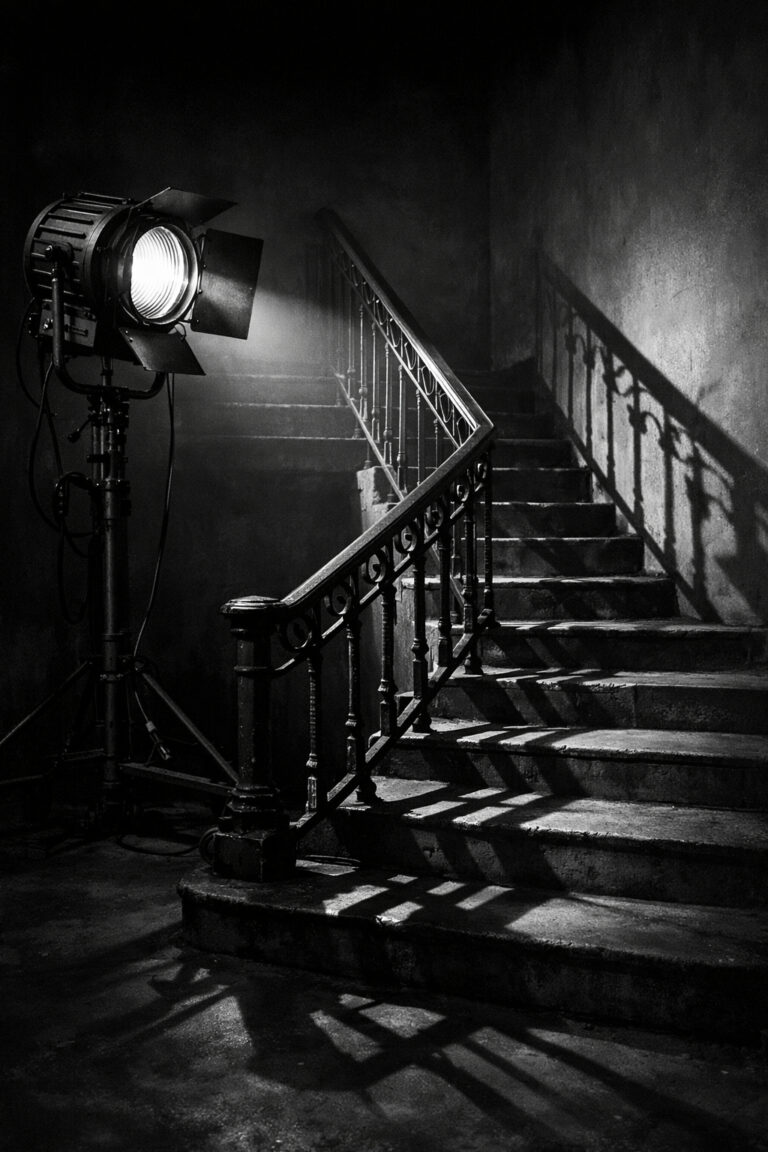
- Low-key lighting. Instead of the even, flattering illumination of a studio romance, scenes are lit from a single hard source, leaving large areas of the frame in black. Faces are half in shadow.
- Shadows as set dressing. Venetian blinds, banister railings and window frames throw stripes and bars across walls and characters, a visual hint of confinement.
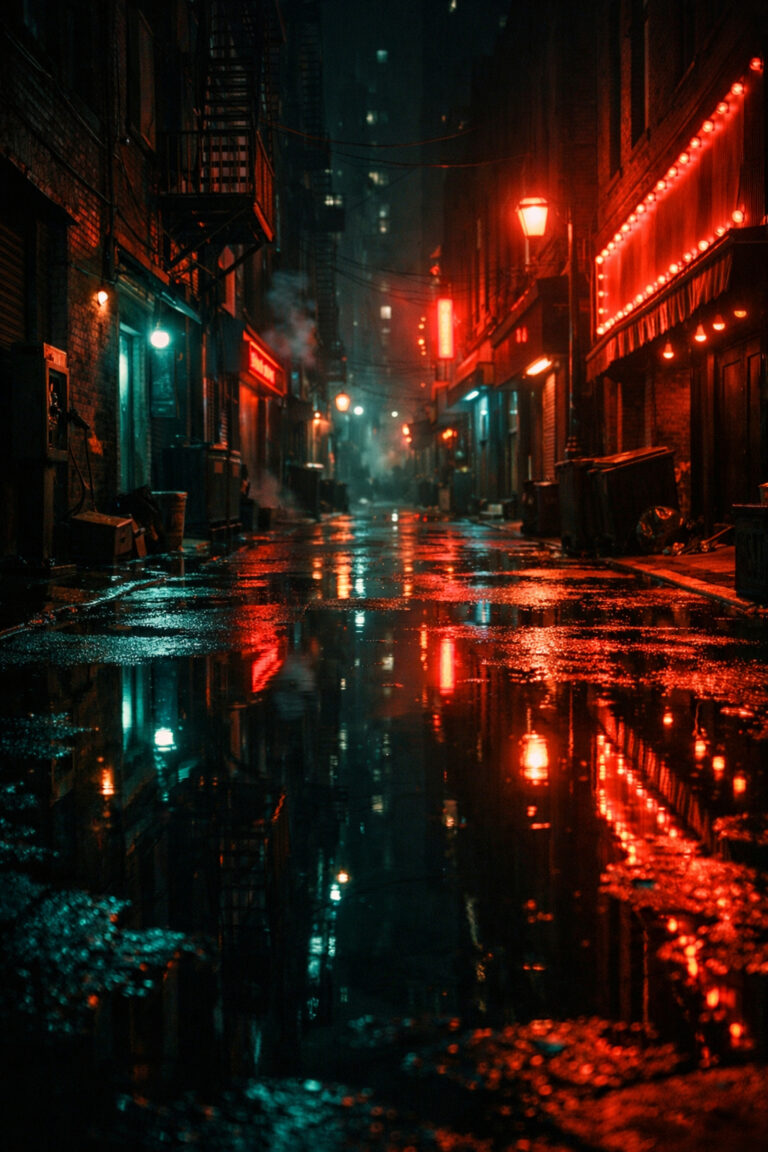
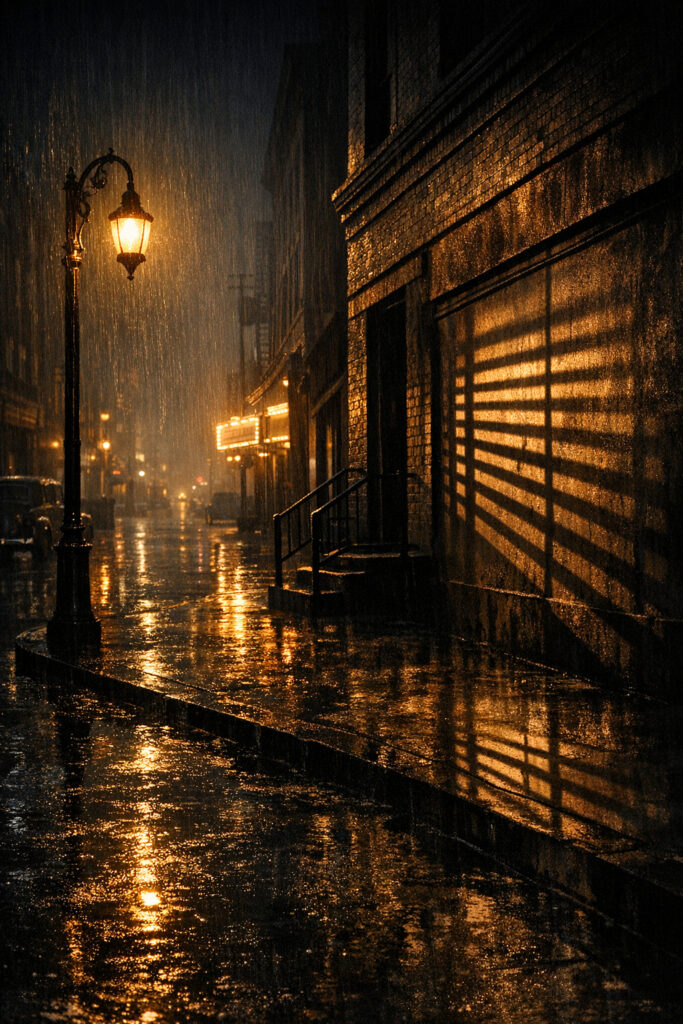
- Night and wet streets. Pavement was often hosed down so it would reflect streetlamps and neon.
- Unsettling angles. Low angles, tilted frames and wide-angle lenses that distort rooms and faces.
- The city as a trap. Cramped apartments, bus stations, diners and hotel corridors, rarely a wide open sky.
Much of this vocabulary came from Europe. German Expressionist cinema of the 1920s had already used distorted shadows to express inner states, and a generation of émigré directors who had worked in Germany and Austria, including Fritz Lang, Billy Wilder, Robert Siodmak, Edgar G. Ulmer and Otto Preminger, ended up making key American noirs. French poetic realism of the late 1930s contributed its own doomed lovers and foggy fatalism. Budgets mattered too: shadows hide cheap sets, and many noirs were modest B-pictures. I go into the cameramen and techniques in more depth in the piece on film noir lighting.
The story signatures
Noir plots vary enormously, but certain moves recur so often that they function like a grammar.
Voice-over and flashback
Many noirs are told in retrospect, by a narrator who already knows how badly things turned out. Double Indemnity begins with its wounded insurance man dictating a confession into an office recorder. Out of the Past has its hero tell his history to the woman he hopes to marry. The effect is fatalistic: you know from the first minutes that nobody escapes, and the suspense is about how, not whether.
The flawed protagonist
The noir lead is usually a man under pressure: a private eye working at the edge of the law, a war veteran who cannot fit back in, a salesman who thinks he has found the perfect crime. He is rarely purely good or purely evil, and the films are interested in the moment he crosses a line.
The femme fatale and her opposite
The dangerous, desirable woman who draws the hero toward ruin is the archetype people remember, though noir women are more varied than the cliché suggests, and many films pair her with a steadier “good” woman the hero fails to choose.
Corruption everywhere
Police, politicians and businessmen are often as compromised as the criminals. Under the Production Code, crime could not be seen to pay, so wrongdoers were punished by the last reel; but the journey there frequently suggested that the whole system was rotten.
Hardboiled source material
A remarkable number of the classic noirs were adapted from the crime fiction of Dashiell Hammett, Raymond Chandler, James M. Cain and Cornell Woolrich, writers who had been publishing in pulp magazines and paperbacks since the late 1920s. Their clipped dialogue and morally gray heroes gave the films much of their attitude.
A quick reference: classic noir at a glance
| Element | What it looks or sounds like | A film that shows it well |
|---|---|---|
| Low-key lighting | Single hard light source, deep blacks | Out of the Past (1947) |
| Confessional voice-over | Narrator recounts his own downfall | Double Indemnity (1944) |
| Private eye | Cynical investigator, murky clients | The Maltese Falcon (1941) |
| Semi-documentary realism | Location shooting, procedural detail | The Naked City (1948) |
| Doomed lovers on the run | Couple bound together by a crime | Gun Crazy (1950) |
| End-of-era excess | Baroque camera, border-town corruption | Touch of Evil (1958) |
What came after
When black-and-white production faded and the old studio system came apart, noir as a cycle ended, but the attitude did not. Directors in France, including the young critics of the New Wave, borrowed from American noir in the 1960s, and American filmmakers returned to it in color in the 1970s with films such as Chinatown (1974). That later tradition is usually called neo-noir, and it is a story of its own.
The simplest answer to the question, then, is that film noir is a name French critics gave in 1946 to a group of dark American crime films, mostly made between about 1940 and 1958, that share a shadowy look, a fatalistic way of telling stories and a deep suspicion of the people in charge. The longer answer is that you learn to recognize it the way you recognize a voice. Watch three or four of the films back to back and the shadows on the wall start to feel familiar.
Where to go next
For a curated viewing list with directors and years, read the best film noir movies. To see how the style survived into color, continue with neo-noir explained.