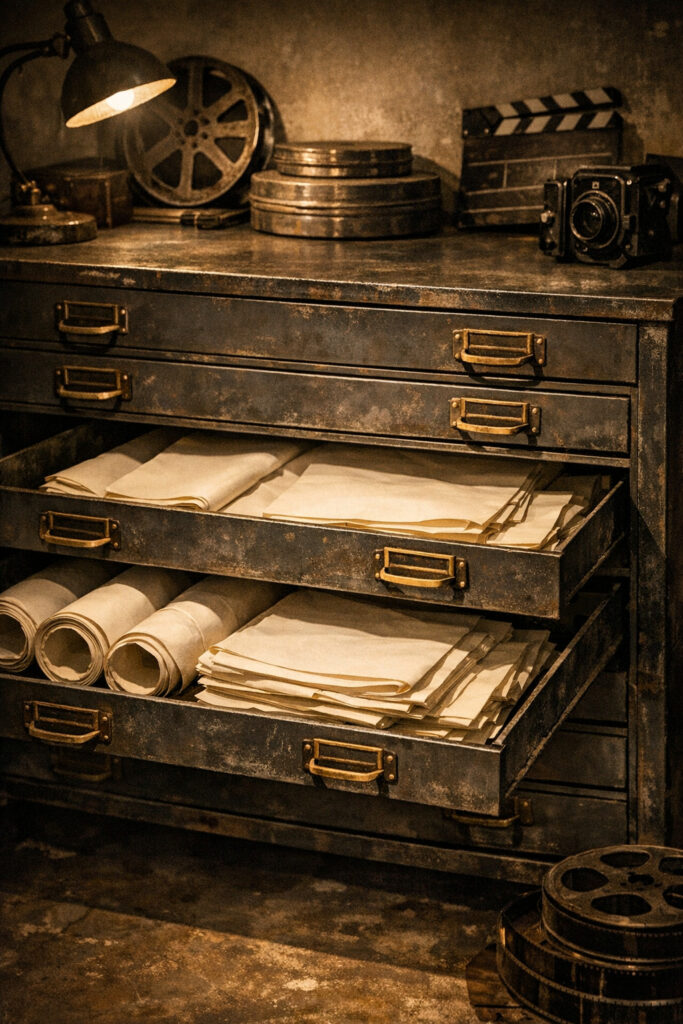
Open a flat file of old theater paper and the first surprise is how little of it is the shape you expect. There is the tall, familiar one-sheet, of course. But next to it lies a long, skinny insert that looks like a bookmark for a giant, a squat landscape sheet that would never fit a modern frame, and a stiff card with a blank band across the top where a small-town theater once lettered its own playdates. Movie poster sizes were not random. Each format was built for a particular spot in or around a cinema, and once you know where each one hung, the whole system makes sense.
This guide covers the standard American formats of the classic studio era, roughly the 1930s through the early 1980s, then the main international sizes. Measurements are the conventional ones; actual sheets vary slightly because of trimming and printing.
The American system at a glance
| Format | Size (inches) | Orientation | Where it went |
|---|---|---|---|
| One-sheet (classic era) | 27 x 41 | Portrait | Outside the theater, in poster frames |
| One-sheet (modern) | 27 x 40 | Portrait | Same job, after the mid-1980s change |
| Half-sheet | 22 x 28 | Landscape | Lobby and entrance displays |
| Insert | 14 x 36 | Portrait | Narrow frames, lobby pillars |
| Window card | 14 x 22 | Portrait | Shop windows around town |
| Lobby card | 11 x 14 | Landscape | Display frames inside the lobby |
| 30 x 40 | 30 x 40 | Portrait | Larger frames and easels |
| 40 x 60 | 40 x 60 | Portrait | Large outdoor and lobby frames |
| Three-sheet | 41 x 81 | Portrait | Building walls, usually in two pieces |
| Six-sheet | 81 x 81 | Square | Walls and fences, usually in several pieces |
| 24-sheet | about 104-108 x 232-246 | Landscape | Roadside billboards, in many pieces |
The “sheet” names come from the billboard trade. The one-sheet was the base unit, and larger posters were described as multiples of it, even when the real dimensions do not divide neatly.
The one-sheet: the poster everyone means
When people talk about a classic movie poster, they nearly always mean the one-sheet. For most of the studio era the American one-sheet measured 27 x 41 inches. In the 1980s the studios moved to 27 x 40 inches, and that has remained the standard. The one-inch difference is small, but it is one of the reasons frame shops ask whether a poster is pre- or post-1980s.
Two other changes came at around the same time. Classic-era one-sheets were usually shipped folded, typically into eighths, and the fold lines are part of how surviving copies look. During the 1980s, rolled shipping replaced folding for new releases, and sources generally place the full switch by about 1990. And from the late 1980s, studios began issuing double-sided one-sheets, with a reversed image printed on the back so the poster glowed properly in the backlit frames that theaters were installing.
One-sheets were frequently issued in several designs for the same film, labeled Style A, Style B and so on, which is why two equally original posters for a single picture can look nothing alike. My overview of classic movie posters looks at how that artwork changed from decade to decade.
Half-sheets, inserts and window cards
Half-sheet (22 x 28 inches)
Despite the name, the half-sheet is not half of a one-sheet in any practical sense. It is a landscape format, wider than it is tall, printed on heavier paper and meant for lobby and entrance displays. Because of the shape, half-sheet designs often rearranged the one-sheet artwork, with figures on one side and the title stretched across the other. Like one-sheets, they sometimes came in more than one style.
Insert (14 x 36 inches)
The insert is the tall, narrow format, at 14 x 36 inches, sized for slim frames on lobby walls and pillars. Inserts were also printed on heavier stock than one-sheets, and in the classic era they were often folded for shipping, though rolled examples exist. The long shape forced designers to stack elements vertically: the star’s face at the top, the action in the middle, the title and credits at the bottom.
Window card (14 x 22 inches)
Window cards were printed on card stock and went out into the town rather than staying at the theater. They were placed in shop windows, barbershops and diners, and they usually had a blank band at the top where the local theater could print or hand-letter its name and playdates. That blank band, filled in or not, is one of the more charming features of the format, because it ties a card to a particular place and week.
The big ones: three-sheets, six-sheets and 24-sheets
The larger formats were built for the outside of buildings and the side of the road. A three-sheet measures about 41 x 81 inches and was normally printed in two sections that a theater worker pasted up together. The six-sheet, at roughly 81 x 81 inches, came in several pieces. The 24-sheet was a true billboard, around nine feet tall and twenty feet wide, assembled from many sections.
Because these posters were pasted directly onto walls and boards, they were meant to be destroyed by weather and by the next campaign. That is why far fewer survive than one-sheets, and why the ones that do often show joins between sections.
The 30 x 40 and 40 x 60 formats were different again. They were printed on heavier paper for display in large frames and on easels, and they often used artwork adapted from the one-sheet.
Lobby cards and their relatives
Lobby cards, at 11 x 14 inches, were the smallest standard theater paper, usually issued in sets of eight with a title card and scene cards. Before about 1940 some prestige releases also had jumbo lobby cards at 14 x 17 inches. I cover their history, the title-card and scene-card system and the role of National Screen Service in what are lobby cards.
International movie poster sizes
Every major film market developed its own formats, sized to its own billboards and print shops. The same film could look very different in each country, both in shape and in design.
| Country | Format | Approximate size | Notes |
|---|---|---|---|
| United Kingdom | Quad | 30 x 40 in, landscape | The main British cinema poster |
| United Kingdom | Double crown | 20 x 30 in, portrait | A smaller British format |
| France | Grande | 120 x 160 cm | Large format, usually folded |
| France | Petite | about 60 x 80 cm | Smaller format |
| Italy | Due fogli (2-sheet) | about 39 x 55 in | A common Italian size |
| Italy | Locandina | about 13 x 28 in | Tall, narrow format |
| Australia | Daybill | 13 x 30 in | Earlier daybills were longer |
| Japan | B2 | about 20 x 29 in | The standard Japanese theater poster |
The British quad deserves special mention. Because it is a landscape format, British designers often reworked American artwork completely, and some films have quads by entirely different artists from their American one-sheets. Hammer’s horror films are a good example, and I touch on them in old horror movie posters.
Same size, different job: advance, re-release and style variants
Size is only one way theater paper is classified. Within a single format there can be several kinds of poster for the same film, and it helps to know the vocabulary before you start comparing sheets.
- Advance or teaser posters went up before a release, often with minimal text and sometimes no release date. They are usually printed to the standard one-sheet size.
- Style variants are alternate designs for the same release in the same format, marked Style A, Style B and so on.
- Re-release posters were printed when a studio reissued an older film. They are original posters for that reissue, often with new artwork or a changed tagline, and in the National Screen Service era their stock number carried an “R” prefix.
- Combination posters advertised two films on one sheet, a common sight in double-feature and drive-in programming.
All of these share the formats in the tables above. Knowing whether a sheet is an advance, a style variant or a reissue tells you more about where it sat in a film’s life than its measurements alone.
A few practical notes on measuring
- Measure the paper, not the image. Most formats include a margin, and printed borders differ from style to style.
- Expect small variations. Trimming at the print shop could add or subtract a fraction of an inch, so a sheet that is slightly off the standard is not unusual on its own.
- Look at the folds. Classic-era one-sheets and many other formats were shipped folded; the pattern of folds is part of the poster’s history, not simply damage.
- Check orientation. Half-sheets, lobby cards and quads are landscape. A “half-sheet” that stands upright is something else.
If you are measuring in order to frame or store a poster, size also determines what kind of folder, sleeve or flat-file drawer you need. That is where the next guide picks up.
Where to go next
For care and display by format, read how to store movie posters and lobby cards. For more on the posters-and-paper side of film history, browse the posters and lobby cards section.