The poster came out of a relative’s closet in a cardboard tube, rolled so tightly it sprang back like a clock spring. One corner had a strip of yellowed tape, the edges had browned and the back smelled faintly of basement. None of that damage happened in a cinema. It happened in the decades afterward, in an ordinary house. If you have ever wondered how to store movie posters and lobby cards so they do not end up like that, the good news is that the basics are simple, inexpensive and mostly about avoiding a few common mistakes.
A note before we start: I am an enthusiast, not a conservator. What follows is general care guidance of the kind museums and archives publish for paper items. For anything already badly damaged, torn, moldy or historically significant, the right step is to consult a professional paper conservator rather than try a fix at home.
What actually harms old posters
Theater paper was never made to last. Many posters were printed on inexpensive paper, and the main enemies of that paper are well understood:
- Acid. Cheap paper and cardboard contain acids that make paper yellow and brittle over time, and acid migrates from one material to another by contact. An old poster stored against ordinary cardboard can pick up a brown stain in the shape of the box.
- Light. Ultraviolet and strong visible light fade inks and weaken paper. Red and some other colors on old posters are especially prone to fading.
- Humidity and temperature swings. Paper expands and contracts with moisture. Damp conditions encourage mold and foxing, the small brown spots familiar from old books; very dry conditions make paper brittle.
- Handling. Most tears, creases and edge damage happen when a sheet is picked up, unrolled or moved without support.
- Adhesives. Ordinary pressure-sensitive tape and household glues stain and can become very difficult to remove.
- Pests. Silverfish and other insects feed on paper and paste, mostly in damp, undisturbed places.
Handling: the first habit to fix
Before storage comes handling, because that is when most accidents happen. A few simple habits go a long way:
- Clean, dry hands. Wash and dry your hands before touching old paper, and keep food, drinks and pens away from the table. Some archives prefer clean cotton or nitrile gloves; others prefer bare clean hands for better grip on thin paper. Either way, the goal is to avoid transferring oils and dirt.
- Support, do not pinch. Lift a poster with a board or folder underneath it rather than by a corner. Large sheets are easier and safer to move with two people.
- Clear a large surface. Unroll or unfold a poster only on a clean table big enough to hold all of it, so no part hangs over an edge.
- Go slowly with rolled paper. A poster that has been rolled for years may resist opening. Let it relax gradually under light, even support instead of forcing it flat in one go.
- Write nothing on the item. Notes about where and when you got something belong on a separate slip or in the folder, not on the back of the poster.
How to store movie posters flat
For most posters and almost all lobby cards, flat storage is the safest choice. It avoids the stress of rolling and keeps the sheet supported.
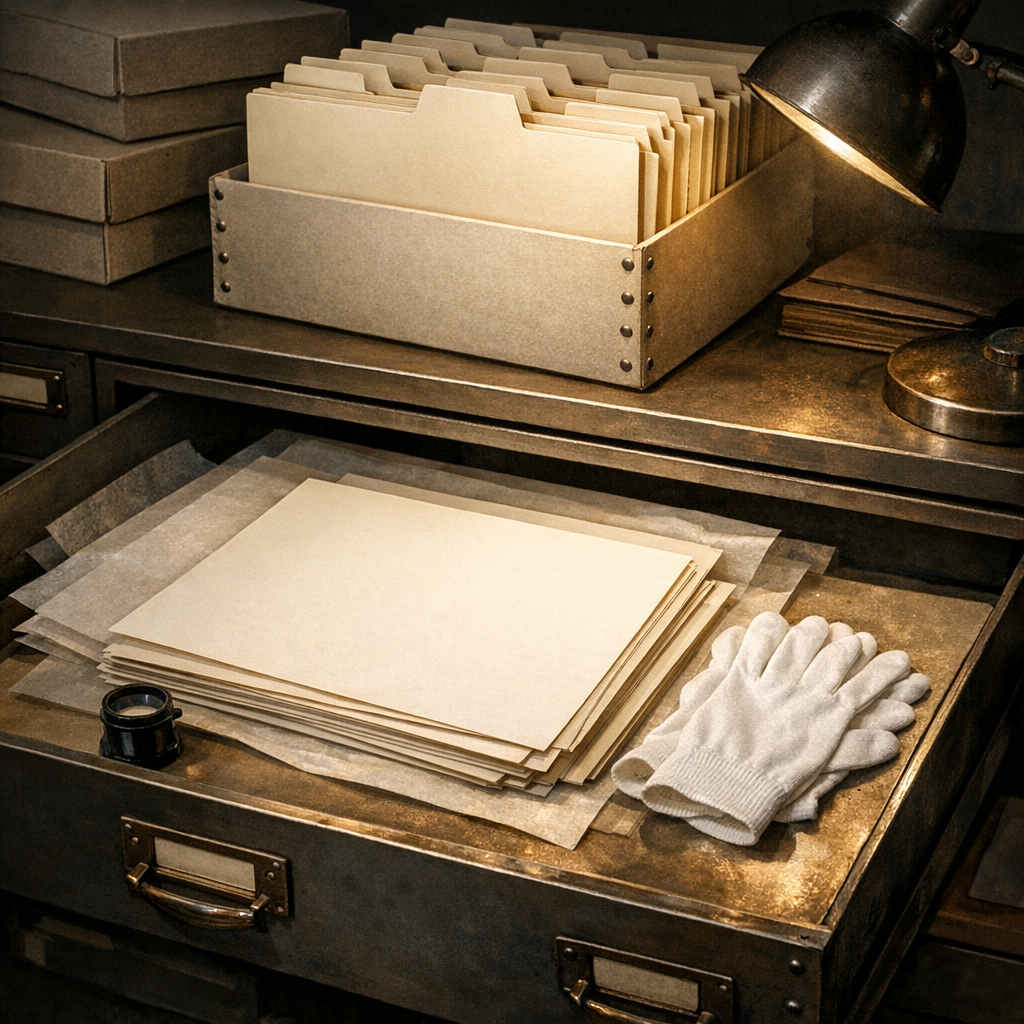
- Use acid-free, lignin-free materials. Folders, interleaving tissue and boxes sold for archival storage are made to avoid the acid problem described above.
- Consider inert polyester sleeves. Clear archival polyester sleeves let you see an item without handling it directly. Avoid PVC sleeves, which can give off harmful chemicals as they age. Sleeves are not recommended for paper that is flaking or has loose surface material.
- Support each sheet. An acid-free board behind a poster or a stack of lobby cards keeps them from bending when you lift them.
- Do not overfill. A drawer or box that is crammed full causes abrasion and creasing every time it is opened.
- Keep it horizontal. Flat files, shallow archival boxes or the space under a bed in a climate-controlled room all work better than a leaning stack in a closet.
Folded posters
For decades, many theater posters were shipped folded, and fold lines are part of how an original classic-era one-sheet usually looks; I explain the formats in movie poster sizes. A folded poster can be stored folded in an acid-free folder, ideally laid flat. Repeatedly opening and refolding along the same lines wears the paper at the folds, so open it only when you need to. Do not iron a poster to remove folds, and do not try to flatten it under heavy weights if it resists; old, brittle paper can crack.
Rolled posters
When a poster is too large to store flat, or arrived rolled, a few habits help:
- Roll around a wide tube rather than a tight core. The larger the diameter, the less stress on the paper and the ink.
- Wrap the roll in acid-free tissue or paper, and keep the outer tube from touching the poster if the tube itself is not archival.
- Store tubes lying down, not standing on end, so the bottom edge is not crushed.
- Do not seal tubes with tape that touches the poster, and avoid rubber bands, which perish and can stain.
Lobby cards need their own care
Lobby cards are printed on heavier card stock, which makes them sturdier than posters but no less vulnerable to acid, light and moisture. They were often pinned, tacked or taped in theaters, so many already carry holes and adhesive residue; there is no need to add more. Store them in individual sleeves with an acid-free backing board, flat or standing upright in a snug archival box, and keep the title card and scene cards of a set together. If you are new to the format, what are lobby cards explains what a set usually includes.
Where to keep them: the environment
The single best thing you can do is choose a stable room. Attics, basements, garages and exterior walls are the usual sources of damage because temperature and humidity swing widely there.
| Factor | General guidance | Why |
|---|---|---|
| Temperature | Moderate and steady, normal living-room range or a little cooler | Heat speeds up the chemical decay of paper |
| Relative humidity | Roughly 35-55 percent, without sudden swings | Damp invites mold and foxing; very dry air makes paper brittle |
| Light | Dark for storage; low, indirect light for display | Light fading is cumulative and cannot be reversed |
| Location | Interior rooms, off the floor, away from pipes and vents | Avoids leaks, condensation and temperature extremes |
| Inspection | A quick check a few times a year | Catches mold, pests or damp before they spread |
A small hygrometer is an inexpensive way to find out what a room actually does over a year. The numbers above are broad ranges used in general collection-care advice, not a precise prescription.
Displaying without damage
Most of us want to see posters on the wall, not just in drawers. Display always involves some risk, but framing choices make a large difference.
- UV-filtering glazing. Glass or acrylic with UV filtering reduces, but does not eliminate, fading. Direct sunlight should still be avoided.
- Acid-free mats and backing. Anything that touches the poster should be archival quality.
- Space between poster and glazing. A mat or spacer keeps the paper from touching the glass, where condensation can make it stick.
- Reversible mounting. Archival corners or hinges hold a sheet in place and can be removed later. Avoid dry mounting, spray adhesives and lamination, which are generally irreversible.
- Rotation. Changing what is on the wall every so often limits how much light any one item receives.
Some older posters you see framed have been backed on linen or paper. Backing is a specialist conservation process with its own trade-offs, and it is a job for a professional, not a weekend project.
Common mistakes to avoid
- Repairing tears with household tape.
- Using pins, thumbtacks or poster putty on an old poster or lobby card.
- Storing items in ordinary cardboard boxes or plastic bins in an attic or basement.
- Cleaning a poster with water, household cleaners or aggressive erasers.
- Rolling a poster tightly, or rolling one that was originally folded.
- Hanging a framed poster opposite a sunny window.
None of this requires a large budget. Most damage comes from a handful of avoidable habits, and a few archival folders, a stable room and some patience prevent a great deal of it.
Where to go next
To learn more about the history behind the paper in your folders, read classic movie posters or browse the posters and lobby cards section.