For the “Cheek to Cheek” number in Top Hat (1935), Ginger Rogers wanted a blue gown covered in ostrich feathers. The dress, made by RKO costume designer Bernard Newman to her specifications, shed feathers with every turn, and accounts of the shoot describe frustration on the set before the problem was brought under control. On screen you see none of it, only a dress that seems to float. That is old Hollywood glamour in miniature: an effect so smooth that it looks effortless, built by a team of specialists who rarely got their names in front of the public.
This piece is about those specialists. Not fashion tips, but the craft: who designed the clothes, who lit the faces, who shot the portraits, and how the studios turned their stars into images that still look extraordinary.
Old Hollywood glamour was a department, not an accident
Every major studio of the 1930s and 1940s kept permanent departments for wardrobe, makeup, hair, art direction and stills photography. A star’s look was planned across all of them. The costume designer worked from the script and the cinematographer’s lighting plan, the makeup head adjusted for the film stock, and the portrait gallery produced images that matched what audiences would see on screen. My overview of the golden age of Hollywood explains how the studio system supported this kind of specialization; here is what it produced.
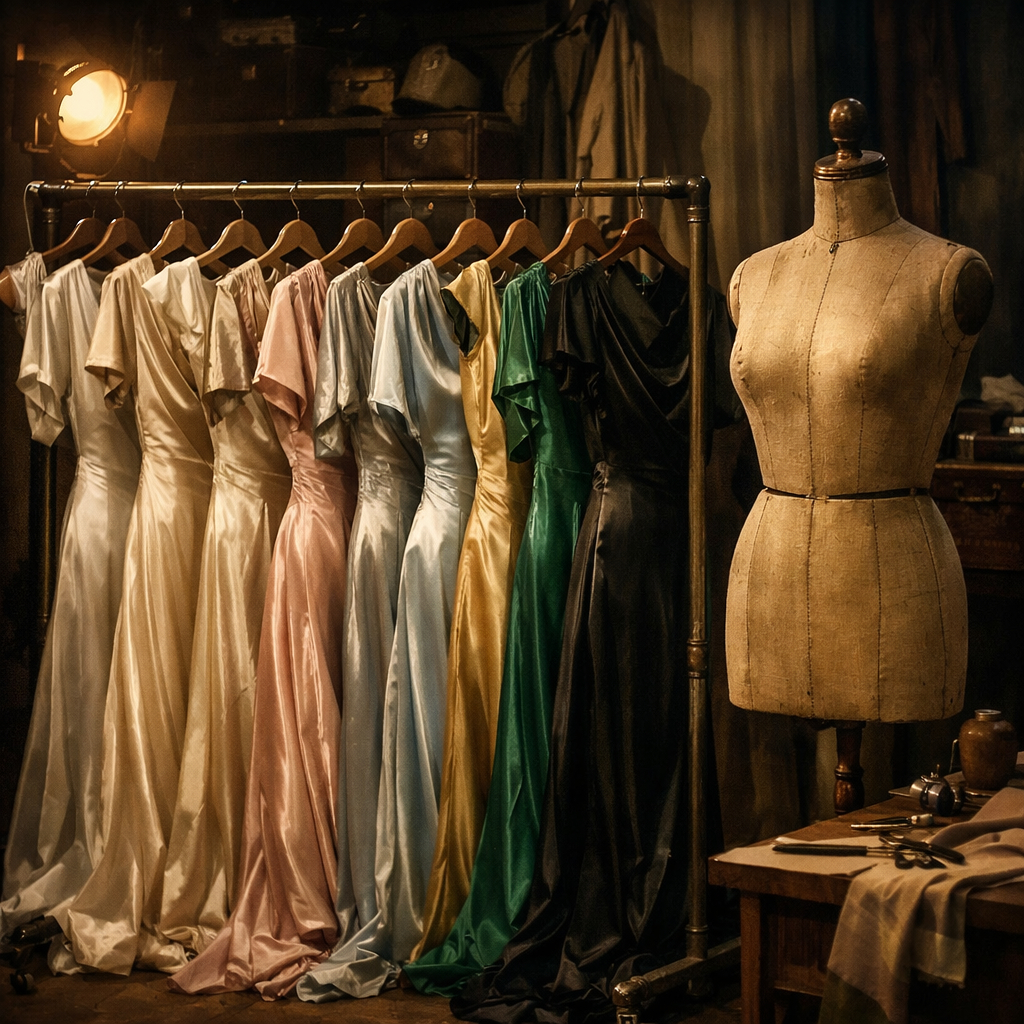
The costume designers
Studio costume designers were among the most influential fashion figures in America, even if most filmgoers never knew their names. A few of the defining ones:
| Designer | Main studio | Known for |
|---|---|---|
| Adrian | MGM | Garbo, Joan Crawford and Norma Shearer; the broad-shouldered Crawford silhouette |
| Travis Banton | Paramount | Marlene Dietrich’s costumes for Josef von Sternberg, Carole Lombard’s gowns |
| Edith Head | Paramount, later Universal | Eight Academy Awards, more than any other woman in any category |
| Orry-Kelly | Warner Bros. | Bette Davis’s films; later Oscars including Some Like It Hot |
| Jean Louis | Columbia | Rita Hayworth’s strapless black satin gown in Gilda (1946) |
| Walter Plunkett | RKO, later MGM | Period costume, above all Gone with the Wind (1939) |
| Bernard Newman | RKO | Ginger Rogers’s gowns in the Astaire-Rogers musicals |
Adrian’s work for Joan Crawford in Letty Lynton (1932), particularly a white dress with enormous ruffled sleeves, became one of the best-known examples of a film costume driving retail fashion. His broad shoulders for Crawford also became her signature line through the decade.
The craft had practical rules that viewers never noticed. Black-and-white film turned color into tone, so designers chose fabrics by how they caught light: satin and lamé for shine, beading for sparkle under a key light, velvet for deep blacks. Bias-cut gowns, a technique associated in Paris with Madeleine Vionnet, suited the camera because they moved fluidly and caught highlights along the body. Costume designers also had to satisfy the Production Code, which meant necklines and fabrics were negotiated as carefully as dialogue.
The Academy did not create a costume design award until the films of 1948, with separate black-and-white and color categories. Edith Head’s first win came the following year for The Heiress (1949), the start of a run that made her the most famous name in the field.
The cinematographers and the light
A gown is only as good as the light falling on it. Studio cinematographers developed a set of techniques for making faces glow, and some stars insisted on working with the same cameraman film after film.
William H. Daniels photographed most of Greta Garbo’s films at MGM, and the soft, luminous treatment of her face owes a great deal to him. Lee Garmes won the Academy Award for Shanghai Express (1932), Josef von Sternberg’s film with Marlene Dietrich. Von Sternberg was closely involved in lighting his own films, and the Dietrich look, with a high key light carving shadows under the cheekbones, became so associated with the studio that this setup is still often called Paramount lighting, or butterfly lighting after the small shadow it casts beneath the nose.
Other tools were less visible:
- Diffusion. Gauze, silk stockings or glass filters over the lens softened skin and lines. Leading ladies often got more diffusion than their co-stars in the same scene, which you can spot once you look for it.
- Eye lights. A small, low-power lamp near the camera put a catchlight in the eyes, making them look alive and wet.
- Backlight. A strong light from behind and above outlined hair and shoulders and separated the star from the background, the halo effect of countless close-ups.
- Angle control. Stars and cameramen learned each face’s best side and best height, and later close-ups were often shot to match.
These are the same tools that film noir cinematographers would later push toward hard shadow and menace. The film noir lighting piece follows that darker branch.
The portrait photographers
Many of the images people think of as old Hollywood glamour never appeared in a film at all. They came from the studios’ portrait galleries, where photographers spent hours on a single star with large-format cameras, careful lighting and heavy negative retouching.
George Hurrell is the best-known name. He was hired as head of MGM’s portrait gallery around 1930, reportedly after Norma Shearer saw his work and wanted to change her image, and his dramatic, high-contrast style became the standard for the decade. He later worked independently and at Warner Bros. Clarence Sinclair Bull made many of the classic Garbo portraits at MGM. Paramount, RKO and Columbia had their own gallery heads, and each studio’s portraits had a recognizable finish.
These photographs had a job to do. They went to newspapers, fan magazines and theaters, and they set the image audiences carried into the cinema. Many were also used as the basis for poster and lobby card artwork, a subject I return to in the posters and lobby cards section.
Makeup, hair and sets
Behind the camera, makeup artists had to work with the film stock. Max Factor developed products specifically for motion picture use, and the Westmore family ran makeup departments at several studios. Changes in film stock in the late 1920s and early 1930s changed how makeup read on screen, and makeup artists adapted. Hairstylists such as Sydney Guilaroff at MGM became powerful figures in their own right.
The sets mattered too. Cedric Gibbons, MGM’s supervising art director for decades and the designer of the Oscar statuette, oversaw the studio’s polished, expensive look. At RKO, Van Nest Polglase’s art department created the gleaming white Art Deco settings of the Astaire-Rogers musicals. A white satin gown against a white set is a lighting problem, and solving it was part of the glamour.
When three-strip Technicolor arrived in features in the mid-1930s, everything had to be rethought. Technicolor sent color consultants, led by Natalie Kalmus, to supervise palettes, and designers learned that some colors photographed very differently from how they looked on the rack.
The last flowering in the 1950s
The studio glamour machine kept running into the 1950s, even as the contract system around it broke down. At 20th Century-Fox, William Travilla designed Marilyn Monroe’s pink gown for the “Diamonds Are a Girl’s Best Friend” number in Gentlemen Prefer Blondes (1953) and the white halter dress from The Seven Year Itch (1955), two of the most recognized costumes of the decade. Edith Head dressed Grace Kelly for Alfred Hitchcock and Audrey Hepburn in Roman Holiday. Widescreen and color changed the lighting problems, but the basic approach, a coordinated team building one star image, was the same one invented in the 1930s.
How to spot the craft while watching
Once you know what to look for, classic films become a different experience. Watch a two-shot and compare how sharply the leading man and leading lady are rendered; the difference in diffusion is often obvious. Notice where the catchlights sit in a star’s eyes, and whether a gown is designed to catch the key light as she walks toward camera. Look at how often a costume change marks a turn in the story. None of it was meant to be noticed, which is exactly why it is so satisfying to notice now.
Five films to watch for the craft
- Shanghai Express (1932, Josef von Sternberg): Banton’s costumes and Garmes’s light on Dietrich.
- Top Hat (1935, Mark Sandrich): RKO’s white sets and the feather gown in motion.
- Camille (1936, George Cukor): Adrian’s period costumes, with Garbo photographed by William Daniels and Karl Freund.
- Gilda (1946, Charles Vidor): Jean Louis’s gown and Rudolph Maté’s photography of Hayworth.
- The Heiress (1949, William Wyler): Edith Head’s Oscar-winning period costume used to tell the story.
Where to go next
Meet the women these teams worked with in old Hollywood actresses, or browse the full Golden Age Hollywood section.