Pause almost any frame from Out of the Past and count how much of the picture is simply black. In many shots it is close to half. A face is lit from one side; the other side vanishes; a lamp in the background makes a small pool of light and the corners of the room disappear. That is the film noir style at its most essential, and it was not an accident or a mood that settled over Hollywood by chance. It was built, shot by shot, by cinematographers and gaffers making specific choices about where to put a light and where to leave it out.
This piece looks at those choices: the techniques, the reasons behind them and some of the cameramen whose names deserve to be as familiar as the directors’. If you want the broader background on the term and its history first, my piece on what film noir is covers it.
Low-key lighting: the core of the film noir style
Classical Hollywood lighting of the 1930s was built on the three-point system. A key light provides the main illumination, a fill light softens the shadows it creates and a back light separates the actor from the background. Used in balance, this produces the bright, even, flattering look of a studio romance or musical. For the glamour side of that tradition, see the piece on old Hollywood glamour.
Noir cinematographers did not throw this system away; they unbalanced it. Reduce or remove the fill light and the shadows from the key light stay deep and hard. Lower the key, move it to the side or below the face, and features become masks. Cut the back light and the actor merges into the darkness behind him. The term for this is low-key lighting, and the result is a high contrast between the brightest and darkest parts of the frame.
Several recurring effects come from this approach:
- Chiaroscuro faces. Half lit, half in shadow, an image that suits characters with something to hide.
- Practical sources. Light that seems to come from a desk lamp, a neon sign or a passing car, which justifies odd angles and pools of light.
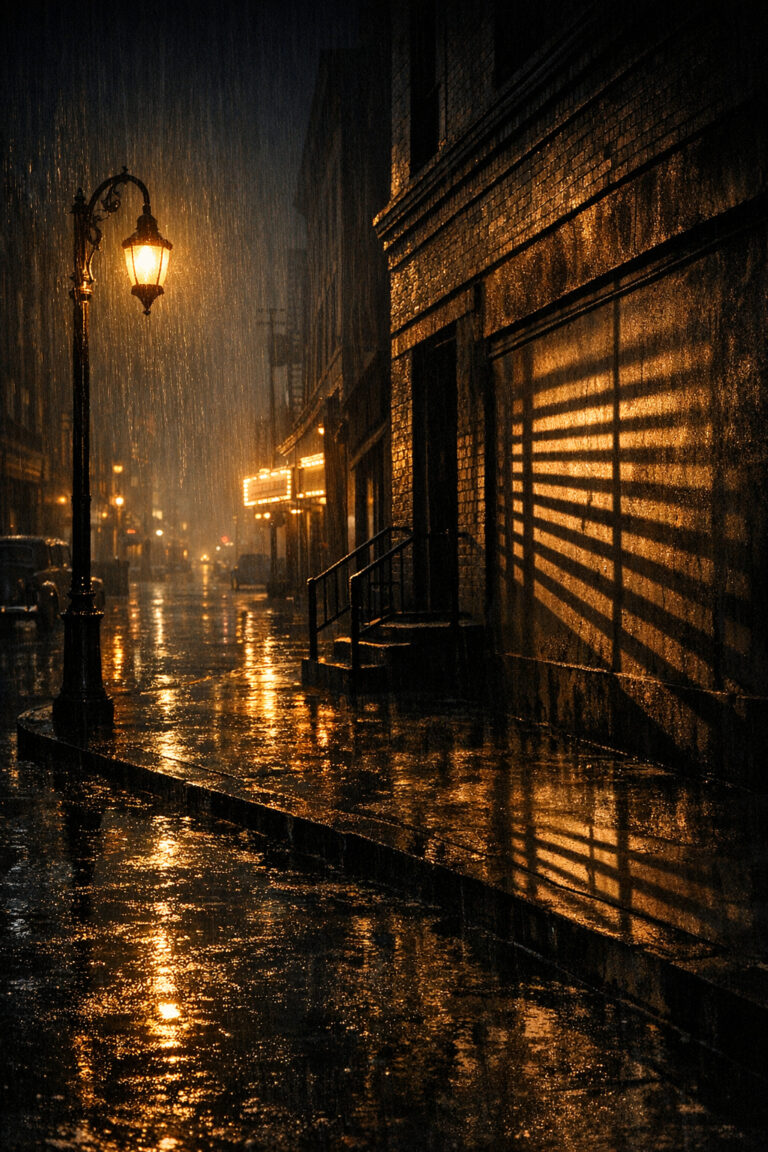
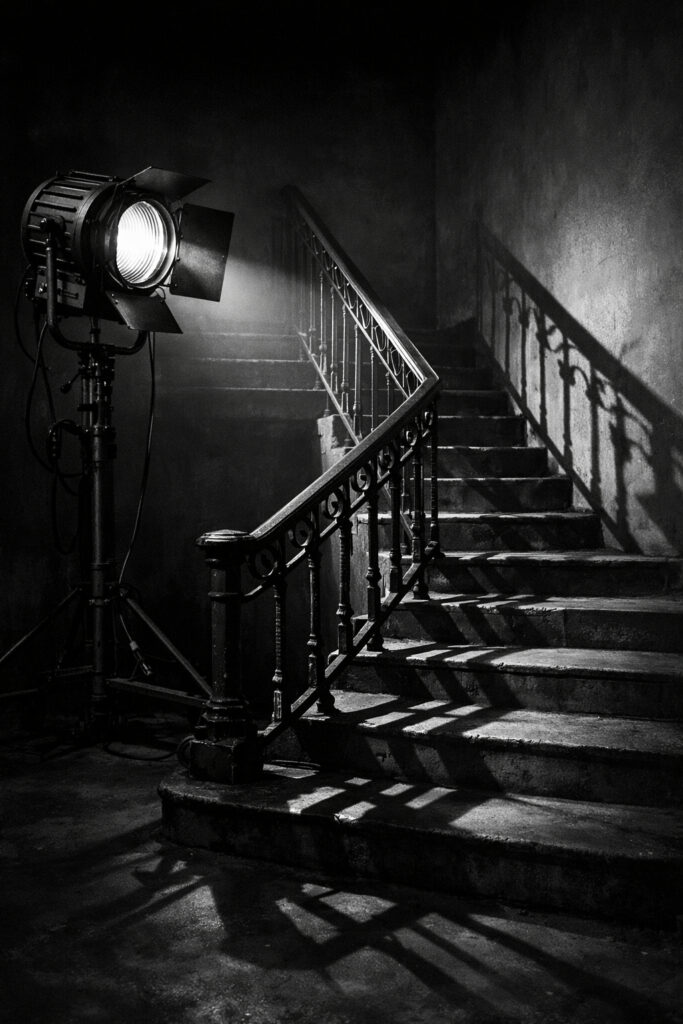
- Patterned shadows. Venetian blinds, stair railings and window frames throwing bars across rooms and people.
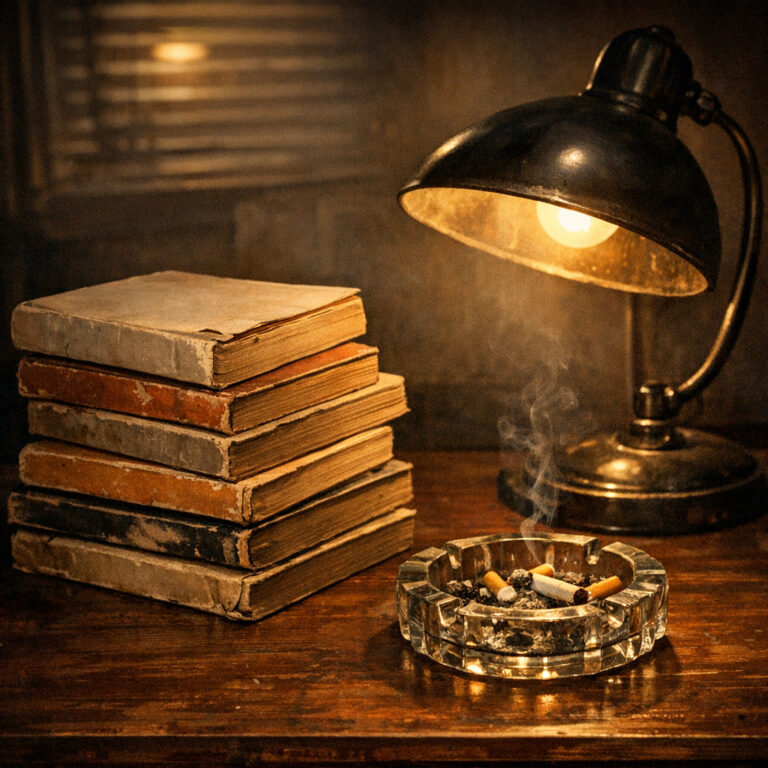
- Under-lighting. A light placed low, as if from a table lamp, that makes ordinary faces look sinister.
- Silhouettes. Figures reduced to outlines in doorways and at the ends of corridors.
Why it looked that way
There are several overlapping explanations, and I think they all hold some truth.
European influence
German Expressionist films of the 1920s had already used exaggerated shadows and distorted sets to express psychological states. Many of the directors who shaped noir, including Fritz Lang, Robert Siodmak and Billy Wilder, came out of the German-language film industry before emigrating, and they brought a visual vocabulary with them.
Budgets and wartime limits
Shadows are cheap. A set that is mostly darkness needs fewer walls, less furniture and less dressing. Many noirs were B-pictures or modest A-pictures, and darkness disguised the economy. Wartime restrictions on materials also encouraged thrift in set construction.
Faster film and better equipment
Improvements in film stock sensitivity and in lightweight lighting equipment during the 1940s gave cameramen more freedom to shoot with less light and, later, to take the camera onto real streets at night.
Story
Most importantly, the look fit the material. Stories about people trapped by their own decisions are well served by images in which characters are literally boxed in by shadow and frame.
Deep focus, wide lenses and tilted frames
Lighting was only part of the style. Gregg Toland’s deep-focus photography for Citizen Kane (1941), which kept foreground and background sharp at once, influenced many noir cameramen. Deep focus let a director stage a scene in layers, with a figure looming close to the lens while another waits in the depth of a room, and wide-angle lenses exaggerated that distance and bent the geometry of ceilings and walls.
Camera angles did similar work. Low angles that show ceilings make rooms feel oppressive. Tilted frames, often called Dutch angles, suggest a world that has slipped off its axis; The Third Man (1949), shot by Robert Krasker, uses them so often that they become part of its identity. High overhead shots could reduce a character to a small figure caught in a maze of streets.
The cinematographers behind the shadows
The table below names cameramen and films whose credits are well documented. It is a starting point, not a complete roll call; dozens of other cinematographers shot noirs, often several each.
| Cinematographer | Noted noir work | What to look for |
|---|---|---|
| Nicholas Musuraca | Stranger on the Third Floor (1940), Out of the Past (1947) | Soft-edged, velvety blacks and pools of lamplight |
| John F. Seitz | Double Indemnity (1944), Sunset Boulevard (1950) | Slatted light, dusty interiors, sun-bleached Los Angeles |
| Joseph LaShelle | Laura (1944) | Polished, mobile camera; Academy Award for black-and-white cinematography |
| John Alton | T-Men (1947), Raw Deal (1948), The Big Combo (1955) | Single hard sources, figures cut out of total darkness |
| William Daniels | The Naked City (1948) | Location shooting in New York; Academy Award winner |
| Robert Krasker | The Third Man (1949) | Dutch angles and wet cobblestones; Academy Award winner |
| Burnett Guffey | In a Lonely Place (1950) | Restrained, intimate darkness around a volatile lead |
| Russell Harlan | Gun Crazy (1950) | The single-take robbery filmed from inside a car |
| Ernest Laszlo | Kiss Me Deadly (1955) | Harsh angles and night roads in a nuclear-age thriller |
| Stanley Cortez | The Night of the Hunter (1955) | Stylized, storybook expressionism |
| Russell Metty | Touch of Evil (1958) | The long opening crane shot and wide-angle grotesquerie |
John Alton, the theorist
Alton is the one cinematographer whose name noir fans tend to know, partly because he wrote about his craft. His book Painting with Light, published in 1949, is one of the few manuals by a working Hollywood cameraman of the period, and his films with director Anthony Mann are textbook examples of the style. In his work a face can be lit by what looks like a single bulb in an otherwise black room, and the effect is both beautiful and threatening.
Nicholas Musuraca at RKO
Musuraca spent much of his career at RKO and shot Stranger on the Third Floor, often cited as the first true noir, with a nightmare sequence that looks lifted from a German silent. Seven years later his work on Out of the Past was gentler but no less dark, full of soft night exteriors and interiors lit as if by a single lamp.
John F. Seitz at Paramount
Seitz had been shooting films since the silent era before he worked with Billy Wilder. In Double Indemnity he gave the Dietrichson house a stale, dim interior where sunlight cuts through the blinds, a fitting home for a plot that is rotten underneath its suburban surface. He shot Wilder’s Sunset Boulevard too.
From soundstage to street
The early noirs were overwhelmingly studio productions, their streets built on backlots and their rain supplied by hoses. After the war a semi-documentary strand took the style outside. The Naked City (1948) was shot extensively on location in New York, and its producer, Mark Hellinger, made a point of the real city in its narration. Films such as T-Men mixed procedural realism with Alton’s expressionist lighting.
Location work changed the texture of noir. Real streets have uneven light and depth that is hard to fake, and night exteriors became grittier. The style was never purely realist, though. Even on location, cameramen added hard sources and wet pavement to keep the shadows deep.
How to watch for it
Next time you see a classic noir, try a simple exercise. In each scene, find the main source of light and ask where it is supposed to come from. Then look at what stays dark and why. You will start to notice how often the framing hides information from you, how a character steps into light at the moment of a revelation and how shadow falls across a face just before a lie.
A good restoration makes a real difference. Noir depends on the gradations between gray and black, and worn prints or poor transfers flatten them. When you can, seek out restored versions through licensed services or public-domain archives that take care with their sources.
Where to go next
To see these cameramen at work, start with my list of the best film noir movies. To see how the style changed when it moved into color, read neo-noir explained.