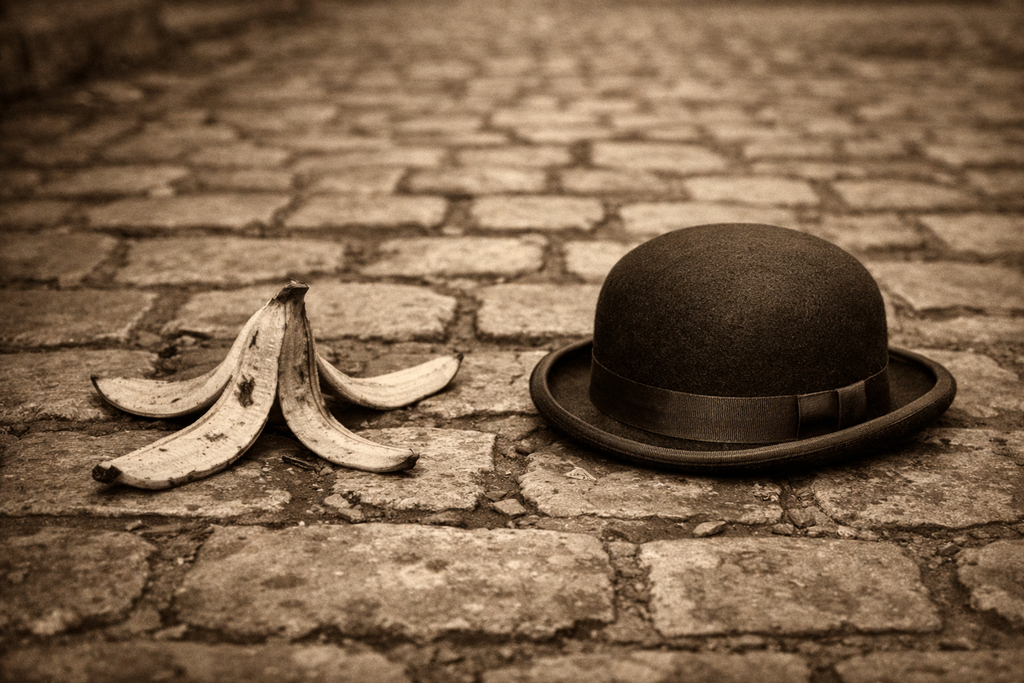
Three men, three images. A small figure in a bowler hat and baggy trousers, twirling a cane as he waddles away down a dusty road. A man with a perfectly still face sitting on the coupling rod of a locomotive as it begins to move. A young man in round glasses dangling from the hands of a clock high above a city street. Those are Charlie Chaplin, Buster Keaton and Harold Lloyd, and between them they define silent comedy for most people who know anything about it. They were contemporaries and rivals, and fans have argued about which one was greatest for about a century. Rather than settle that argument, this piece compares what each man actually did differently.
Where silent comedy came from
American screen comedy in the 1910s was shaped heavily by Mack Sennett’s Keystone studio, famous for fast, chaotic slapstick, chases and pratfalls. Short films of one or two reels were the standard unit. All three of our comedians came out of that world in one way or another, and all three then pushed beyond it toward feature-length films with real characters and stories. By the mid-1920s comedy features were among the most popular and inventive films Hollywood made.
Charlie Chaplin: the Tramp
Born in London in 1889 and trained in English music hall, Chaplin joined Keystone in 1914. The Tramp costume appeared that year, and audiences responded so strongly that the character became the most recognized figure in world cinema within a couple of years. He moved quickly through Essanay and Mutual, where shorts such as Easy Street and The Immigrant (both 1917) showed him mixing slapstick with social observation and real feeling.
His features are the core of his reputation: The Kid (1921), The Gold Rush (1925), with its dance of the bread rolls and the boiled-boot dinner, The Circus (1928), City Lights (1931) and Modern Times (1936). Notice those last two dates. Chaplin held on to silent technique long after the industry had switched to talking pictures, adding synchronized music and sound effects but keeping the Tramp wordless.
His method: character first. Chaplin’s comedy grows out of the Tramp’s personality, his pride, his mischief and his loneliness. He was willing to slow a film down for sentiment, and his endings often reach for pathos rather than a final laugh. He wrote, directed, produced and starred, and in later films composed the music too. He was famously a perfectionist, reshooting scenes over and over until he was satisfied.
Buster Keaton: the Great Stone Face
Keaton grew up on the vaudeville stage in his family’s act, the Three Keatons, where being thrown around the stage was part of the show. He entered film in 1917 working with Roscoe “Fatty” Arbuckle, then from 1920 starred in his own shorts, among them One Week (1920) and Cops (1922), before moving to features.
The run of features from 1923 to 1928 is one of the great creative streaks in film history: Our Hospitality (1923), Sherlock Jr. (1924), The Navigator (1924), Seven Chances (1925), The General (1926), co-directed with Clyde Bruckman, and Steamboat Bill, Jr. (1928), with its famous shot of a house front falling around him, an open window passing exactly over where he stands.
His method: engineering and deadpan. Keaton’s character never smiles, which earned him the nickname “the Great Stone Face,” and he faces a hostile universe of machines, weather and crowds with calm, practical ingenuity. He loved large-scale physical gags filmed in long, wide takes so audiences could see there was no trick. He performed his own stunts at real risk. The General, built around a stolen locomotive during the Civil War, used real trains and a real crash, and is now ranked among the greatest films ever made, though it disappointed at the box office on release.
In 1928 Keaton signed with MGM and lost the independence that had made his best work possible. His later career had real low points, but critics and audiences rediscovered his silent films in the 1950s and 1960s, and his reputation has only grown since.
Harold Lloyd: the glasses character
Lloyd worked mainly with producer Hal Roach. After early success with a Chaplin-like character called Lonesome Luke, he created his lasting persona around 1917: a bright, eager, ordinary young man in round horn-rimmed glasses, determined to get ahead. In 1919 a prop bomb that turned out to be real exploded in his hand during a photo session, costing him a thumb and forefinger. He went on to perform dangerous climbing stunts anyway, usually wearing a prosthetic glove that hid the injury.
His best-known features include Safety Last! (1923), directed by Fred C. Newmeyer and Sam Taylor, with the clock-hanging sequence; Girl Shy (1924); The Freshman (1925), a college-football comedy; The Kid Brother (1927) and Speedy (1928), shot partly on the streets of New York.
His method: the go-getter in trouble. Where Chaplin’s Tramp is an outsider and Keaton’s hero a stoic, Lloyd’s character is one of the crowd, a recognizably modern American trying hard to succeed. His “thrill comedies” built suspense and laughs together, often using clever camera placement to make heights look terrifying. He was a superb businessman, owned most of his films, and released them at a steady pace that made him enormously popular through the 1920s.
The three compared
| Charlie Chaplin | Buster Keaton | Harold Lloyd | |
|---|---|---|---|
| Screen character | The Tramp, an outsider with dignity | A stoic who never smiles | An eager young man in glasses |
| Comic engine | Personality, pantomime and pathos | Physics, machines and timing | Ambition, embarrassment and suspense |
| Key collaborator or base | His own studio, releasing through United Artists | Producer Joseph Schenck until 1928 | Hal Roach, then his own company |
| Signature feature | The Gold Rush (1925), City Lights (1931) | The General (1926), Sherlock Jr. (1924) | Safety Last! (1923), The Freshman (1925) |
| Famous image | The Tramp walking away down the road | The falling house front | Hanging from the clock |
| Sound era | Resisted dialogue until The Great Dictator (1940) | Lost control at MGM; later rediscovered | Made talkies through the 1930s, then largely retired |
So who was the greatest?
It depends on what you value. For decades the conventional answer was Chaplin. His films reached more people around the world than almost anyone’s, and his mix of laughter and sentiment made him the first filmmaker many intellectuals took seriously as an artist. In more recent decades many critics and filmmakers have championed Keaton, whose cool, inventive style looks remarkably modern and whose stunts still astonish. Lloyd has had the least critical attention of the three, partly because his films were harder to see for many years, but anyone who watches Safety Last! or The Freshman with an audience knows how well they still play.
The Academy recognized all three, eventually. Chaplin received a special award for The Circus at the very first ceremony and an honorary award in 1972. Lloyd received an honorary award in 1953, and Keaton one in 1960.
My own advice is not to choose. They are doing different things, and the contrast makes each one funnier.
A starter pack: one short and one feature each
- Chaplin: The Immigrant (1917), then The Gold Rush (1925)
- Keaton: One Week (1920), then The General (1926)
- Lloyd: one of his late-1910s glasses shorts, then Safety Last! (1923)
Watch with music, ideally with other people; comedy is a group experience, and these films were timed for audiences laughing together. Many are in the public domain in the United States and may be found through public-domain archives or licensed services, though restored versions with proper scores are well worth seeking out. For tips on frame rates and choosing good restorations, see my guide to silent movies and where to start.
Beyond the big three
The three giants were not alone. Harry Langdon had a short, brilliant run in the mid-1920s with his childlike persona. Laurel and Hardy began their partnership in the late silent period and carried it triumphantly into sound. Mabel Normand was one of Keystone’s biggest stars and directed films herself. Each deserves a look once the big three have hooked you. And if your interest is the dramatic side of the period rather than the comic, my companion piece on silent film stars covers Pickford, Valentino, Garbo and the coming of sound.
Where to go next
Follow comedy into the talkie era with screwball comedy, or browse more from the period in the Silent Era section.