The first time I sat through a silent feature in a real theatre, with a pianist improvising in the dark below the screen, I expected to be patient. I did not expect to forget, about twenty minutes in, that nobody was talking. That is the secret most people never discover about silent movies: the good ones are not a primitive version of cinema waiting for sound to arrive. They are a complete art form with its own grammar, and once your eye adjusts, they can be as gripping as anything made since. The trick is choosing the right first films and watching them under conditions that give them a fair chance.
Why silent movies deserve a fair hearing
By the mid-1920s filmmakers in Hollywood, Germany, France, Scandinavia and the Soviet Union had developed an extraordinarily sophisticated visual language. Camera movement, lighting, editing rhythm and performance were all expected to carry the story, because words could only appear on intertitle cards between shots. The best directors used as few of those cards as they could. F.W. Murnau’s The Last Laugh (1924) famously tells almost its whole story without them.
The era ended quickly. Warner Bros. released The Jazz Singer in October 1927, and within about three years Hollywood had converted almost entirely to synchronized sound. A generation of technique was abandoned rather than refined, which is why the late silent films can feel so strikingly modern. They were made at the peak of a craft that was about to vanish.
Ten silent movies to start with
This is not a “greatest ever” list. It is a sequence designed for newcomers: varied in country and genre, mostly well restored, and each one a good argument for the period.
| Film | Year | Director | Why start here |
|---|---|---|---|
| The General | 1926 | Buster Keaton and Clyde Bruckman | A Civil War chase comedy built on real locomotives and astonishing physical precision |
| Nosferatu | 1922 | F.W. Murnau | The vampire film everyone half-knows; short, eerie and shot partly on real locations |
| The Cabinet of Dr. Caligari | 1920 | Robert Wiene | Painted, crooked sets and a twist structure that still feels daring |
| Battleship Potemkin | 1925 | Sergei Eisenstein | The Odessa Steps sequence is the most studied piece of editing in film history |
| Metropolis | 1927 | Fritz Lang | Science-fiction spectacle on a scale few films have matched since |
| Sunrise: A Song of Two Humans | 1927 | F.W. Murnau | A simple love story told with breathtaking camerawork |
| The Passion of Joan of Arc | 1928 | Carl Theodor Dreyer | Close-ups of Renée Falconetti that many viewers never forget |
| The Crowd | 1928 | King Vidor | An ordinary man in an enormous city; quietly devastating |
| Man with a Movie Camera | 1929 | Dziga Vertov | No story, no intertitles, just a dazzling city symphony |
| City Lights | 1931 | Charles Chaplin | Released in the sound era with a synchronized score; its final scene is famous for a reason |
If you only try three
Start with The General, because comedy is the easiest way in, and Keaton’s deadpan style looks surprisingly contemporary. Follow it with Nosferatu, which runs well under two hours and works on pure atmosphere. Then try Sunrise, which won awards at the very first Academy Awards ceremony, including the prize for Unique and Artistic Production and, as part of a combined award, Best Actress for Janet Gaynor. If those three land, you are ready for the rest of the list.
Comedy deserves its own path, and I have written a separate comparison of Chaplin, Keaton and Lloyd for anyone who wants to start there. If faces draw you in more than gags, my guide to the great silent film stars covers the dramatic and romantic leads who filled the movie palaces.
How to watch: five practical tips
1. Never watch in true silence
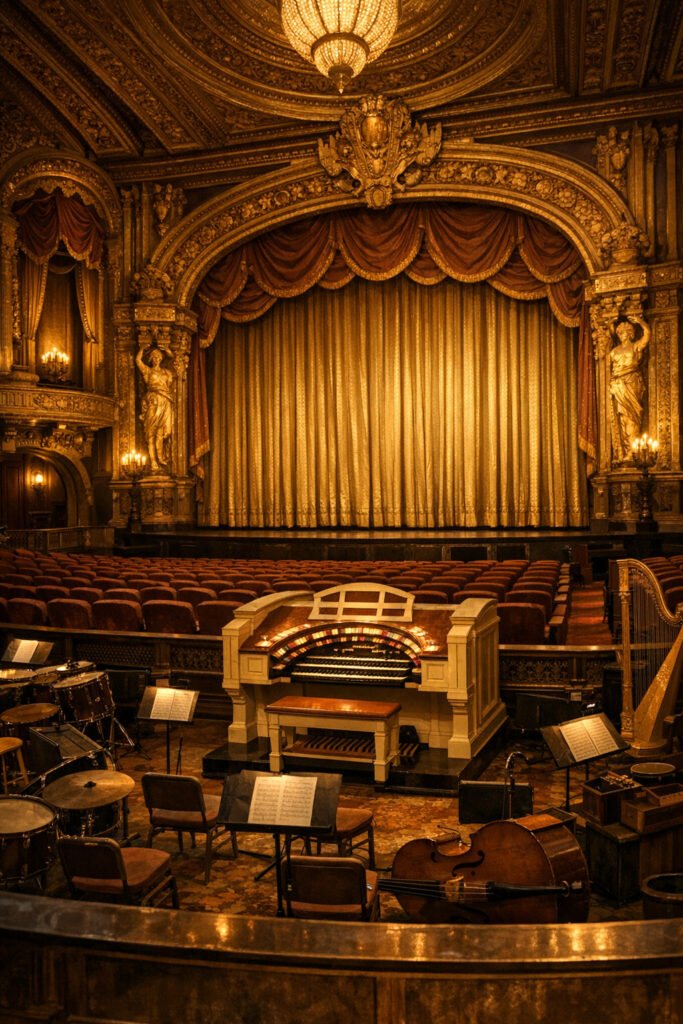
“Silent” films were almost never shown silently. Even small-town theatres had a pianist, and big city movie palaces had orchestras and theatre organs. A good score is half the experience. Modern restorations usually come with a newly recorded or reconstructed score, and the difference between a good one and a bad one is enormous. If a version you find has no music at all, or a random library track, look for another.
2. Watch at the right speed
There was no single standard frame rate before sound. Cameras were hand-cranked, and projection speeds varied with the period, the studio and even the projectionist. Run a 1915 film at the 24 frames per second that sound later standardized and everyone scurries like a cartoon. That jerky, sped-up look many people associate with old movies is usually a transfer error, not how the films looked to their audiences. Careful restorations correct for it.
3. Give intertitles a moment
The cards are read at your own pace in your head, and modern viewers often find them slow at first. After a film or two you will read them in a glance. Some, especially in comedies, are written as jokes in their own right.
4. Expect color
Many silent prints were tinted or toned: blue for night, amber for lamplight, red for fire. Good restorations reproduce this, and it changes the mood of a film completely. If everything you see is flat grey, you may be watching an old television transfer rather than a restoration.
5. Choose a big screen when you can
Repertory cinemas, film societies and festivals still screen silents with live music. Festivals such as Le Giornate del Cinema Muto in Pordenone, Italy, and the San Francisco Silent Film Festival are built around exactly that. One evening of a 1920s feature with a live score will convert more people than any number of laptop viewings.
How much of the silent era survives?
Less than most people assume. In 2013 the Library of Congress published a study by historian David Pierce on American silent features made between 1912 and 1929. It found that only about 14 percent survive complete in their original 35mm form. Another 11 percent survive complete only as foreign-release versions or in smaller formats such as 16mm, about 5 percent survive incomplete, and roughly 70 percent are lost entirely.
The causes were mundane. Nitrate film stock was flammable and decayed with time. Studios saw old films as worthless once sound arrived, and prints were melted down for their silver or simply thrown away. Vault fires destroyed whole collections. What we have today is often a matter of luck, which is why some survivals read like detective stories:
- A complete print of Dreyer’s original cut of The Passion of Joan of Arc, long thought destroyed, was found in 1981 in a closet at a psychiatric hospital near Oslo.
- In 2008 a 16mm copy of Metropolis containing about 25 minutes of footage missing for decades turned up at the Museo del Cine in Buenos Aires, leading to a far more complete restoration in 2010.
- Smaller titles, like Universal’s 1926 lumber-camp drama The Ice Flood, sometimes survive only through reduction prints kept by private collectors.
Even the earliest features can be precarious. British adaptations such as Hepworth’s David Copperfield (1913) survive, while its Walter Scott film of the following year has an unknown status.
Where can you see them?
Many silent features are in the public domain in the United States, and they may be found through public-domain archives or licensed services. For the best experience, though, look for restorations released by film archives and specialist labels. They usually credit the archive that supplied the source material, list the running time and frame rate, and name the composer of the score. That information is a good sign that someone has taken care over the transfer.
Libraries are another underrated source: many lend restored silent films on disc, and some host screenings. And keep an eye on local repertory cinemas, which often program a silent with live accompaniment around Halloween (Nosferatu is a perennial) or on Valentine’s Day (Sunrise works beautifully).
A few common worries
“Won’t the acting look exaggerated?” Some of it does, especially in films from before about 1915 and in melodramas that borrowed from the stage. By the 1920s, though, performances in films like The Crowd or Sunrise can be remarkably restrained. The camera got closer, and actors learned that small gestures read on a large screen.
“Aren’t they slow?” Some are, and so are some modern films. Comedies, serials and adventure pictures of the 1920s are often faster-paced than people expect. Start with those if pace worries you.
“Do I need to know the history?” Not at all. Each film on the list above works on its own terms. The history is a bonus that makes the second and third viewings richer, and it is why sections like the posters and lobby cards archive here are fun once you are hooked.
Where to go next
Meet the people whose faces sold these films in silent film stars and the coming of sound, or browse everything in the Silent Era section.