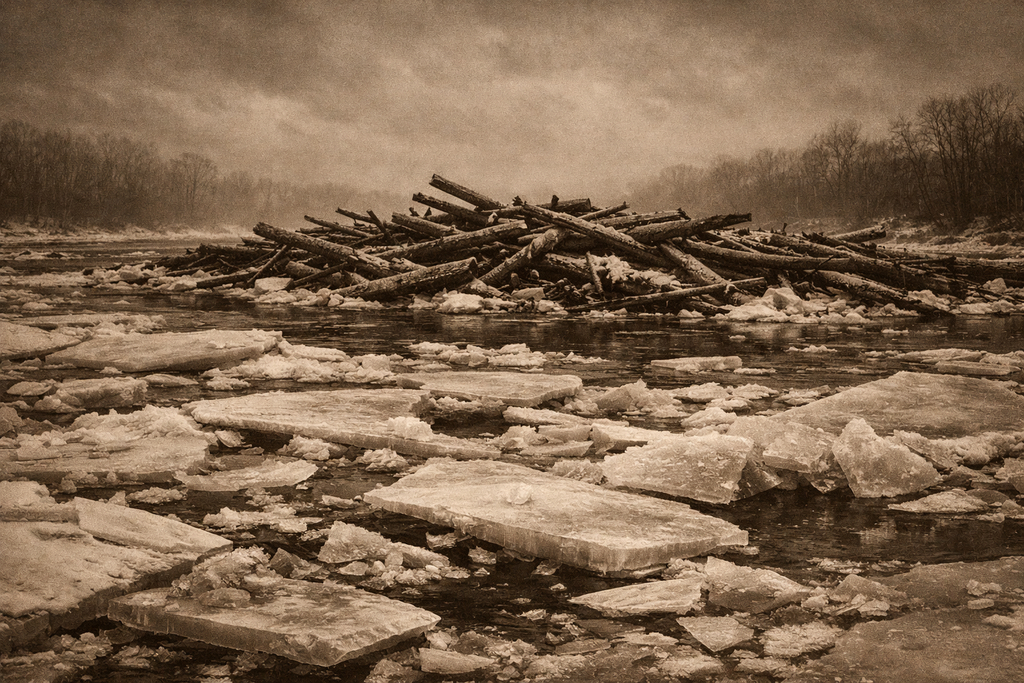
A college boxing champion walks into a lumber camp full of men who settle every argument with their fists, and keeps his title to himself. That is the setup of the ice flood 1926, a modest Universal programmer that most film books skip entirely. It deserves a little more attention than that. It was directed by a veteran of the great adventure serials, adapted from a story by the man who created Zorro, shot partly on location in the Oregon winter, and it ends with exactly what the title promises: a rescue on breaking river ice. It also survives, which is more than can be said for most American features of its year.
The Ice Flood 1926: credits
| Detail | Information |
|---|---|
| Studio and distributor | Universal Pictures (released as a Universal-Jewel production) |
| Presented by | Carl Laemmle |
| Director | George B. Seitz |
| Scenario | George B. Seitz and Gladys Lehman |
| Adaptation | James O. Spearing |
| Source | Johnston McCulley, the novelette The Brute Breaker |
| Cinematography | Merritt B. Gerstad |
| Editing | Raymond Curtiss; Maurice Pivar, supervising editor |
| Intertitles | Walter Anthony |
| Release | Usually given as 2 October 1926; at least one reference also notes a January 1927 date |
| Length | Six reels, 5,747 feet, roughly an hour |
| Format | Black and white, silent, English intertitles |
Cast
| Actor | Role |
|---|---|
| Kenneth Harlan | Jack De Quincy |
| Viola Dana | Marie O’Neill |
| Frank Hagney | “Dum-Dum” Pete, the camp bully |
| Fred Kohler | “Cougar” Kid |
| DeWitt Jennings | James O’Neill, Marie’s father |
| George Irving | Thomas De Quincy, Jack’s father |
| Norman Deming | “Dumb” Danny |
| Billy Kent Schaefer | Little Billy |
| Kitty Barlow | The camp cook |
Some smaller credits are disputed. James Gordon is usually listed as the camp physician, though one reference work flags even that as uncertain and notes that another catalogue mistakenly gave him the role of Jack’s father. A young Walter Brennan is often listed in an uncredited bit as a lumberjack, years before his three Academy Awards, but because he cannot be confirmed from the credits themselves I would treat that as likely rather than certain. One list also queries an appearance by Henry B. Walthall, which I have not been able to confirm at all. Spellings vary too: the hero’s surname appears as both De Quincy and De Quincey.
The story (with the ending kept vague)
Jack De Quincy is a freshly minted Oxford graduate and the son of a wealthy lumber man. His father sends him to bring order to a set of French Canadian logging camps where the work has been sliding into chaos under the rule of bullies. Jack goes in quietly, hiding both who he is and the fact that he was a college boxing champion.
He catches the eye of Marie O’Neill, the daughter of the camp superintendent, and when he dances with her he crosses Pete, the toughest man in camp. The fight that follows is the first of the picture’s set pieces. Jack wins, and the defeated faction goes looking for revenge. After they lose a stash of stolen liquor, they order him out. When he sets up a camp of his own they plan an ambush, and a trick with a dummy by the campfire leaves them believing they have killed him. They then seize Marie and her father, and Jack has to turn the tables before the spring thaw turns the river into the floating ice field that gives the film its name.
None of this is surprising, and it isn’t meant to be. This is a genre piece built from familiar parts: the disguised gentleman, the camp bully, the plucky heroine, the climactic rescue in a natural disaster. The pleasure is in how the parts are assembled.
From The Brute Breaker to The Ice Flood
Johnston McCulley is remembered today for one creation, Zorro, who first appeared in his 1919 serial story The Curse of Capistrano. But McCulley was a prolific pulp writer across many genres, and The Brute Breaker was one of his outdoors stories, published in All-Story Weekly in 1918.
Universal had already filmed it once. The Brute Breaker (1919) was directed by Lynn Reynolds and starred Frank Mayo, with its logging-camp scenes reportedly shot near Mount Shasta in California. Remaking its own properties a few years later was normal practice for the studio, which had a large library of stories and a constant need for product. The Ice Flood kept the French Canadian logging setting and the conflict between a newcomer and the camp’s ruling bullies, and built the finale around the river ice.
| Film | Year | Director | Lead |
|---|---|---|---|
| The Brute Breaker | 1919 | Lynn Reynolds | Frank Mayo |
| The Ice Flood | 1926 | George B. Seitz | Kenneth Harlan |
George B. Seitz and the people in front of the camera
Seitz is the most interesting name on the credits. He made his reputation in the 1910s on action serials, first as a writer on Pearl White chapter plays such as The Perils of Pauline and The Exploits of Elaine (both 1914), then directing serials of his own, and occasionally acting in them. Serial work taught directors to stage fights, chases and cliffhangers quickly and cheaply, and those skills are exactly what a lumber-camp melodrama needs. Seitz later moved to MGM, where from the late 1930s into the 1940s he directed around a dozen of the Andy Hardy pictures with Mickey Rooney. The Ice Flood sits in the middle of that career, a journeyman assignment for a reliable craftsman.
Viola Dana had been a star at Metro in the late 1910s and early 1920s, known for lively, spirited heroines. Kenneth Harlan was a dependable leading man of the decade. Fred Kohler, as the Cougar Kid, was one of the great heavies of silent and early sound Westerns, with a face built for villainy.
Filming in Oregon
The exteriors were shot on location around Klamath Falls, Oregon, with interiors filmed on the Universal lot in California. Local accounts describe a Universal crew arriving in town early in 1926, which makes sense for a film that needed real winter conditions, snow and ice. The camp scenes and river exteriors would have benefited from the setting; the climactic flood itself, according to the trade review of the time, was helped along with miniatures.
Reception
The best-documented contemporary response is a positive review by C.S. Sewell in The Moving Picture World, a leading trade paper of the day. Sewell praised the fight scenes and the film’s “generous use of miniatures” for its effects. That is about what you would expect a trade critic to note: exhibitors wanted to know whether a picture delivered the action its posters promised, and by that standard it seems to have done its job.
Modern viewers who have seen the surviving version tend to describe the story as routine and the flood effects as impressive for 1926 but basic by later standards. I have not found box-office figures and won’t speculate about them.
Does The Ice Flood survive?
Yes, though the details are not entirely settled. A complete print survives and has been issued on home video by several small labels specializing in silent and public-domain titles, which is how most people have seen it. Accounts of archival holdings differ: one widely used silent-film reference lists the surviving material as 8mm reduction prints in private collections, while other sources report a complete 16mm print and a copy at the Library of Congress. I can’t reconcile those from published information, so the safest statement is that the film survives in at least small-gauge form and has circulated, and that the quality of what you see will depend on which source a given release came from.
The film is in the public domain in the United States, so it may be found through public-domain archives or licensed services. Given that the majority of American silent features are lost, any surviving 1926 Universal programmer is worth having, even in a soft reduction print.
Why seek it out
The Ice Flood is not a lost masterpiece, and pretending otherwise would do it no favours. What it offers is a clear look at the bread-and-butter studio picture of the late silent period: an hour long, built on a tested story, staffed by professionals who knew exactly what a Saturday audience wanted. It pairs well with the ice-floe rescue in D.W. Griffith’s Way Down East (1920), the most famous scene of its kind, if you are curious how a studio programme picture handled a similar idea six years later on a smaller budget.
For more on how films like this were sold, the history of lobby cards explains the theatre-front material that advertised pictures of this kind, and my guide to silent movies for beginners is a good place to work out how a programmer like this fits into the decade.
Where to go next
Meet the actors who headlined the decade in silent film stars, or browse more from the period in the Silent Era section.