In 1958 François Truffaut was not welcome at the Cannes Film Festival. As a critic he had attacked the French film establishment so savagely that he was left off the guest list. A year later he was back, this time as a director, and his first feature, The 400 Blows, won him the festival’s prize for best director. That turnaround, from banned critic to celebrated filmmaker in twelve months, is the story of the French New Wave in miniature.
What the French New Wave was
The French New Wave, or Nouvelle Vague, is the name for a burst of filmmaking in France from about 1958 to the mid-1960s, when dozens of young directors made their first features. The label came from journalism rather than from the filmmakers themselves; the weekly L’Express used “nouvelle vague” in 1957 for a survey about the country’s younger generation, and critics soon applied it to the new directors.
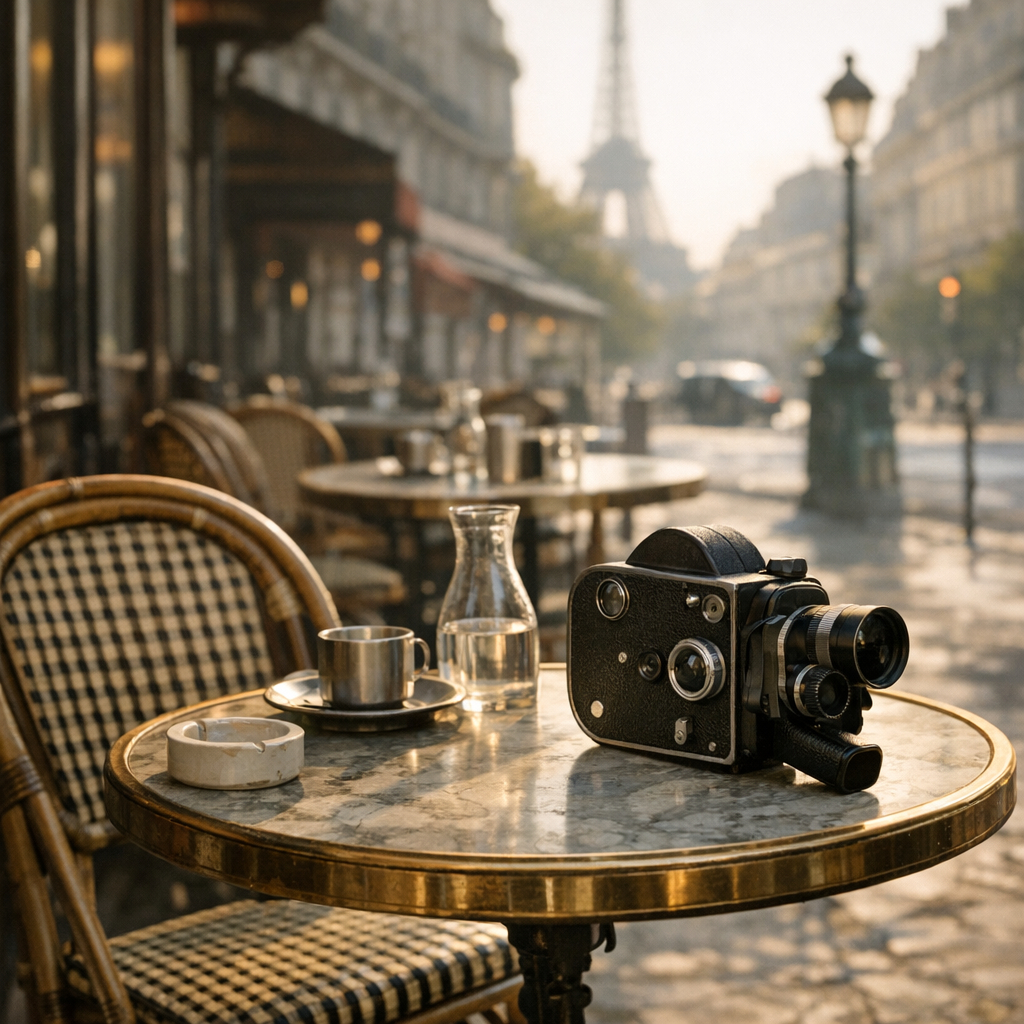
There was no single manifesto, but the films shared recognizable habits. They were made cheaply, often with small crews, lightweight cameras and natural light. They were shot on the streets of Paris rather than on studio sets. They broke the conventions of smooth continuity editing, used jump cuts and direct address to the camera, quoted other films freely, and treated the director, not the screenwriter or the studio, as the true author of a film.
The critics at Cahiers du cinéma
The movement’s core grew out of a magazine. Cahiers du cinéma was founded in 1951 by André Bazin, Jacques Doniol-Valcroze and Joseph-Marie Lo Duca. Bazin, a gentle and brilliant theorist of realism, became a mentor to a group of young writers who spent their days at the Paris Cinémathèque watching everything they could: Truffaut, Jean-Luc Godard, Claude Chabrol, Éric Rohmer and Jacques Rivette.
In January 1954, Truffaut published an essay titled “A Certain Tendency of French Cinema.” It attacked the respectable, literary studio films of the day, which he called the “tradition of quality,” for being written by screenwriters and merely illustrated by directors. Against them, the Cahiers critics championed directors whose personality showed through every film, whatever the script. They praised Jean Renoir and Robert Bresson in France and, provocatively for the time, Hollywood studio directors such as Alfred Hitchcock and Howard Hawks. This idea became known as the politique des auteurs, and in English as the auteur theory.
From criticism to cameras
Between 1958 and 1960 the critics turned into filmmakers almost all at once. Chabrol’s Le Beau Serge (1958) is often counted as the first New Wave feature. Truffaut’s The 400 Blows followed in 1959, dedicated to Bazin, who had died the previous year. Then came Godard’s Breathless (1960), from a story outline by Truffaut, with Chabrol credited as technical adviser.
The 400 Blows (1959)
Truffaut drew on his own difficult childhood for the story of Antoine Doinel, a Paris boy who drifts from trouble at school to petty theft and a reform institution. Jean-Pierre Léaud played Antoine, and Truffaut went on to follow the character through four more films over twenty years, ending with Love on the Run (1979). The final shot, a freeze-frame on Antoine’s face at the edge of the sea, is one of the most famous endings in film.
Breathless (1960)
If The 400 Blows is the New Wave’s heart, Breathless is its nervous system. Jean-Paul Belmondo plays a small-time car thief who idolizes Humphrey Bogart, and Jean Seberg plays the American student he falls for. Cinematographer Raoul Coutard shot much of it handheld on Paris streets, and Godard cut the film with abrupt jumps inside scenes that looked like mistakes to some viewers in 1960 and like freedom to others. Almost every edgy, self-aware crime film since owes it something.
The key directors and essential films
| Director | Background | Essential New Wave films |
|---|---|---|
| François Truffaut | Cahiers critic | The 400 Blows (1959), Shoot the Piano Player (1960), Jules and Jim (1962) |
| Jean-Luc Godard | Cahiers critic | Breathless (1960), Vivre sa vie (1962), Contempt (1963), Band of Outsiders (1964), Pierrot le Fou (1965) |
| Claude Chabrol | Cahiers critic | Le Beau Serge (1958), Les Cousins (1959) |
| Éric Rohmer | Cahiers critic and later editor | The Sign of Leo (made 1959), the early Moral Tales |
| Jacques Rivette | Cahiers critic | Paris Belongs to Us (1961) |
| Agnès Varda | Photographer, Left Bank group | La Pointe Courte (1955), Cléo from 5 to 7 (1962) |
| Alain Resnais | Documentary editor and director, Left Bank group | Hiroshima mon amour (1959), Last Year at Marienbad (1961) |
The Left Bank: the other New Wave
Not every important director of the period came from Cahiers. A second, looser group, often called the Left Bank, included Alain Resnais, Agnès Varda and Chris Marker. They were generally a little older, closer to literature, documentary and the visual arts, and more interested in memory, politics and formal experiment than in Hollywood genre.
Varda’s La Pointe Courte, made in 1955 in a fishing quarter of the town of Sète, predates the critics’ features by several years and is often called a forerunner of the whole movement. Her Cléo from 5 to 7 follows a young singer through Paris in close to real time as she waits for the results of a medical test. Resnais’s Hiroshima mon amour, written by Marguerite Duras, premiered at Cannes in the same year as The 400 Blows and stunned audiences with its fractured treatment of time and memory.
How to spot a French New Wave film
- Location shooting in Paris, with real cafés, streets and apartments, often in available light.
- Handheld and lightweight cameras, giving scenes a loose, spontaneous feel.
- Jump cuts and broken continuity, reminding you that you are watching a film.
- Film references everywhere, from posters on walls to characters imitating movie stars.
- Young, restless characters who talk about love, books and cinema at length and rarely settle down.
- Open or abrupt endings that resist neat resolution.
Many of these habits came from necessity as much as theory. Small budgets ruled out studios and stars, so the directors made a style out of what they could afford. They had also absorbed the lessons of Italian neorealism, especially Roberto Rossellini, whose freedom with story and location the Cahiers critics greatly admired.
The love affair with Hollywood
One of the most surprising things about the French New Wave is how much it adored American films. Breathless is dedicated to Monogram Pictures, a Hollywood studio that specialized in low-budget B-movies. Truffaut’s Shoot the Piano Player is adapted from an American crime novel by David Goodis. Truffaut later recorded a long series of interviews with Alfred Hitchcock that became the book Hitchcock/Truffaut (1966), still one of the best books ever written about directing. If you want the American side of that conversation, our guide to classic Hollywood directors covers the filmmakers the French critics championed, and the crime films they loved are the subject of what is film noir.
Where to start
- The 400 Blows. The most emotionally direct entry point.
- Breathless. Watch it soon after, and the difference in style is the lesson.
- Cléo from 5 to 7. A portrait of Paris and of a woman’s inner life that still feels fresh.
- Jules and Jim. Jeanne Moreau at the center of a love triangle across two decades.
- Hiroshima mon amour. Save it for when you are ready for something more demanding.
Most of these films have been restored and are distributed through licensed services and repertory programs.
Why it still matters
The French New Wave proved that a young director with a small crew and a strong point of view could make a film that mattered internationally. That idea fed directly into the new waves of the 1960s in Czechoslovakia, Brazil, Japan and elsewhere, and into the American independent filmmakers of the following decades. Several of the directors kept working for decades afterward, and their later films took them in very different directions, from Rohmer’s conversational comedies to Godard’s ever more radical essays. The auteur theory reshaped how critics write about films and how audiences talk about them. When you call a movie “a Scorsese film” or “a Hitchcock picture,” you are using the language those Paris critics made common.
Where to go next
See where the New Wave sits among other national movements in our beginner’s map of world cinema classics, or head east to the golden age of Japanese cinema.